10/30/2026
Dialing in On Strawberries
Stacey Rocklin

Strawberries require close attention to detail, especially as production shifts toward protected cultivation. As growers look to maximize every acre, soilless systems offer advantages over field production, including more consistent moisture management, reduced soil-borne disease pressure and more efficient fertilizer use. These benefits make growing media selection one of the most critical decisions in the system.
For Hetty Verlinden of Verlinden Farms, home of Harry's Berries in Norfolk County, Ontario, Canada, evaluating substrates is part of continuous improvement. By testing new products and challenging conventional practices, the farm fine-tunes its system to support higher yields and consistent fruit quality.
Growing more with protected production
Originally rooted in greenhouse vegetable production, the Verlinden family transitioned from hydroponic Boston lettuce into berry production with a focus on efficiency, innovation and long-term sustainability.
“This was originally supposed to be our test plot,” Hetty said. “Now it’s grown into what we have today. We’re always developing, trying new things and finding ways to become as efficient as possible in the smallest footprint.”
Today, the farm produces strawberries in elevated tabletop systems, while blackberries are grown on trellises in containers. Growing in substrate rather than soil has dramatically changed how the operation manages production.
“About 3 acres of strawberries here is equivalent to roughly 20 acres of traditional field production,” Hetty explained. “We have better control over irrigation and fertilizer, less disease pressure, and we can produce much more efficiently.”
Substrate cultivation also creates a more predictable growing environment. By controlling irrigation and nutrition instead of relying on variable weather and soil conditions, growers can respond more quickly to crop needs.
 Managing water more effectively
Water management remains one of the biggest challenges in substrate-grown berry production. A substrate must retain enough moisture for healthy root development while draining efficiently enough to maintain oxygen in the root zone for nutrient uptake. That balance is critical because irrigation and fertility programs depend on predictable moisture levels.
Tabletop strawberry production at Verlinden Farms in Norfolk County, Ontario, Canada.
Substrates that stay saturated too long delay irrigation and nutrient applications while limiting oxygen availability, creating conditions favorable to pathogens. Substrates that dry too quickly may require more frequent irrigation, increase labor and stress plants during hot weather. These challenges help explain why coco coir has long been an industry standard, however, coir often requires frequent irrigation and leaching to maintain the right moisture and air balance.
As Verlinden Farms expanded berry production, Hetty evaluated several substrate options against the farm’s goals, monitoring moisture retention, drainage, irrigation scheduling and crop performance throughout the season.
“The biggest thing I was looking at was moisture management,” she said. “You need a mix that holds enough moisture, but still drains properly. If you can’t control that balance, it becomes difficult to keep your fertility program on track.”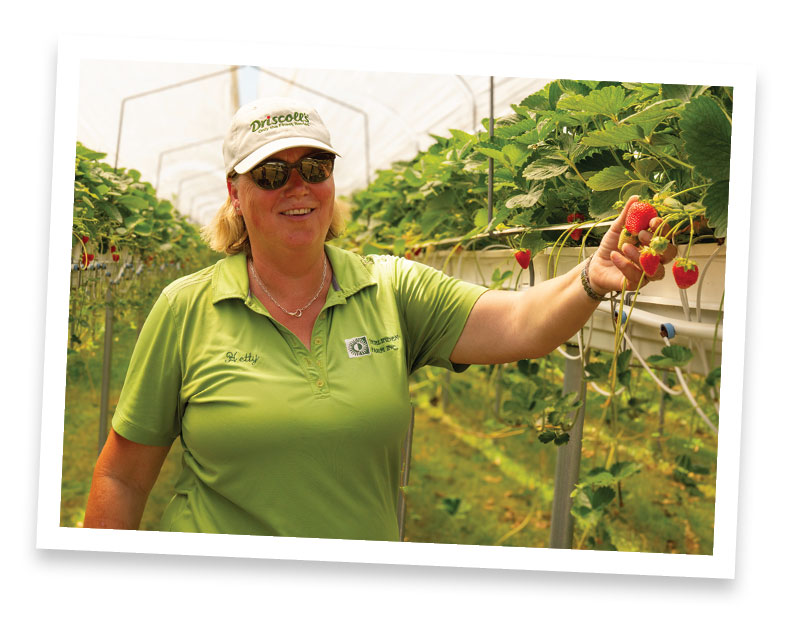
Among the products trialed, Berger BM5 Super HP (high porosity)—a substrate composed of peat moss, wood fiber and perlite—provided the balance she was looking for.
Hetty Verlinden of Verlinden Farms.
“What really attracted me to BM5 Super HP was that it held moisture better, but still allowed me to get the substrate back to the moisture level I wanted,” Hetty said.
This balance of water-holding capacity and air space is especially valuable during high humidity, when substrates can remain wet longer than expected. Faster oxygen recovery after irrigation helps reduce extended wet cycles that favor plant pathogens.
“Sometimes, with other substrates, it would take two days before I could feed again because the substrate wouldn’t dry enough,” she explained. “With BM5 Super HP, I can manage that moisture much better and keep feeding the way I want.”
For containerized strawberries, that consistency is essential. Even short interruptions to irrigation or fertility affect growth, flowering, fruit size, Brix and overall yield.
“These systems aren’t very forgiving,” she said. “If you miss watering or feeding, you’ll see it right away. But when you find the right substrate and the right irrigation strategy, the results are outstanding.”
Along with providing greater control over irrigation, BM5 Super HP contributed to higher berry yields during the trial, helping validate the farm’s decision to adopt the mix.
 Supporting strong root development
Healthy roots are the foundation of productive berry crops. A medium that maintains both moisture and air throughout the root zone helps plants establish quickly and produce consistently.
Successful berry production depends on balancing moisture retention and drainage.
Greenhouse strawberry growers typically maintain a pH of 6.0 to 6.2 and an EC of 2.0 mmhos/cm or less using the saturated media extract (SME) method. BM5 Super HP supports healthy roots by providing consistent moisture and air space for oxygen exchange without requiring a large leaching fraction at each irrigation. Growers who monitor EC levels leach only when salt levels exceed 2.0 mmhos/cm.
Because peat releases moisture more slowly than coir, BM5 Super HP holds water and nutrients longer, making moisture available at a rate better suited to crop growth while allowing air to return quickly after irrigation. Since coir drains faster than the crop can use the moisture, crops grown in coir generally need more frequent irrigation than those grown in BM5 Super HP.
For Hetty, confidence in the substrate’s response across changing weather lets her team optimize irrigation instead of constantly reacting to the media.
Benefits beyond strawberries
The same moisture management advantages also proved valuable in the farm’s blackberry production.
As the farm explores blackberry propagation, Hetty began using BM5 Super HP around the coir plugs supplied with blackberry canes.
“Straight coir became rock hard and dried out so quickly. We were constantly watering, especially during hot weather,” she said. “By packing BM5 Super HP around the coir (plugs), it retained moisture much better and gave us a little more flexibility. It made the system much more forgiving.”
That added moisture buffer reduced irrigation frequency while helping maintain stable conditions around developing roots.
The experience reinforced an important lesson: Different crops may benefit from alternative substrate solutions rather than a single standard approach.
 The value of consistency
While performance is essential, consistency from one shipment to the next is equally important. Growers spend significant time fine-tuning irrigation schedules, fertilizer programs and environmental controls, so changes in substrate characteristics can disrupt established management practices.
The added moisture buffer reduced irrigation while supporting root development in blackberries.
“We’ve used other suppliers before and sometimes the substrate isn’t the same from one year to the next,” Hetty said. “With Berger, we’ve found the consistency is there. You know what you’re getting.”
That consistency provides confidence when planning production, allowing growers to spend less time adjusting programs and more time improving crop performance.
Hetty also encourages growers to evaluate growing media based on their own production systems rather than following industry trends.
“Coir may be common in the industry, but that doesn’t automatically make it the best choice,” she said. “You always have to keep looking at what’s next and what works better for your farm.”
Testing new products at a small scale, monitoring results carefully and making decisions based on measurable performance are central to the farm’s continuous improvement process.
Berger also supports customers through an internal Research & Development team. In a two-year strawberry substrate study using coco coir as the control, Berger found BM5 Super HP outperformed coir in overall yield and berry size while matching its fruit’s Brix performance. The results were achieved with less leaching and fewer irrigation events, reducing fertilizer costs and water use.
Finding the right fit for your operation
As more berry growers adopt protected, substrate-based production, selecting the right growing media becomes an increasingly important management decision. The right substrate improves irrigation efficiency, supports healthy roots, simplifies fertility management and contributes to consistent crop performance.
For Verlinden Farms, a willingness to evaluate new media and refine production practices supports a productive, efficient operation prepared for modern berry production. Berger is proud to support growers with consistent growing media and technical expertise that help build reliable systems and deliver repeatable results season after season. IG
Stacey Rocklin is a grower advisor at Berger. Find more information and grower resources at berger.ca.