7/31/2026
VPD, Temperature & Everbearing Strawberries
Roberto Lopez, Pin-Jui Chen, Nick Cooley & Josh Vander Weide
Editor's Note: At the request of the authors, the Greenhouse VPD Ranges section has been updated in this online article. The updated information will appear in the Winter Inside Grower print edition, as well.
Vapor pressure deficit (VPD) is increasingly monitored by greenhouse and indoor growers because modern environmental control systems can display it in real time, allowing growers to adjust humidity, ventilation and temperature to maintain specific VPD targets. The underlying assumption is straightforward: If VPD influences transpiration, nutrient uptake, disease incidence and photosynthesis, then optimizing VPD should improve crop performance, quality and ultimately yield.
Figure 1. A range of vapor pressure deficits can be found in controlled environments.
 While the physiological importance of VPD is well established, our recent research at Michigan State University aimed to determine the influence of greenhouse VPD and air temperature on physiological performance, berry quality and yield of three everbearing strawberry cultivars.
Understanding why VPD matters
VPD describes the difference between the amount of moisture currently in the air and the maximum amount of moisture the air can hold at saturation. Unlike relative humidity, which varies directly with temperature, VPD is a more precise indicator of atmospheric evaporative demand and the primary driver of plant water loss through transpiration. When VPD is low, the air is nearly saturated with water vapor and transpiration slows. When VPD is high, plants lose water more rapidly through their leaves. Importantly, transpiration is more than simply water loss. It drives the movement of water and nutrients from the roots to shoots, leaves and fruits, helps cool the leaves, and supports photosynthesis.
Greenhouse VPD ranges
Sticking/Misting and Storage of Cuttings and Bare-root Plants—Very Low VPD (<0.3 kPa) Unrooted cuttings have little capacity to replace water lost through transpiration. Maintaining a very low VPD at stick helps prevent excessive water loss until callus and roots develop. As rooting progresses, VPD can gradually be increased to encourage transpiration and acclimate plants to production conditions. When the air temperature in a propagation house is set to 70, 73 or 75F, the relative humidity should be 88, 89 or 90% to achieve a VPD of 0.3 kPa. Very low VPD also slows substrate drying and can keep foliage wet for extended periods (Figure 1). These conditions increase the likelihood of foliar pathogens, particularly when leaves remain wet overnight. Conversely, for short-term storage of bare-root plants, air temperatures should be maintained between 32 and 40F, with a relative humidity of 50 to 64%.
Mid to Late Propagation Stages—Low VPD (0.3 to 0.7 kPa) This VPD range represents a relatively humid propagation environment and is generally the minimum for most rooted crops. This VPD range occurs at approximately 64-85% RH at 68F, 70-88% RH at 70F, and 74-89% RH at 72F. The moderate gradient between water-saturated leaves and the surrounding air allows plants to transpire, but at a relatively slow rate. This can be desirable during cutting propagation after roots have begun to develop, when excessive water loss should still be avoided (Figure 1). At mid- to high-VPD ranges, leaves generally dry more quickly than they would under very low VPD, while substrate moisture is still conserved. There is also some movement of water and nutrients through the plant. Maintaining low VPD for extended periods after plants become established can create problems. For example, strawberries grown under a low VPD during both the day and night can be more susceptible to calcium deficiency.
Target for Most Production—Moderate VPD (0.7 to 1.3 kPa) A VPD of 0.7 to 1.3 kPa is a useful target range for many established greenhouse crops. This corresponds to approximately 33-64% RH at 63F, 38-67% RH at 65F, and 70-44% RH at 68F. Within this range, the atmosphere is neither excessively humid nor excessively dry. Plants generally have sufficient transpiration to support water and nutrient movement from the roots to the shoots, while water loss remains manageable (Figure 1). Moderate VPD also promotes relatively rapid leaf drying after irrigation or periods of high humidity. This can reduce the duration of leaf wetness and help suppress conditions favorable for foliar pathogens.
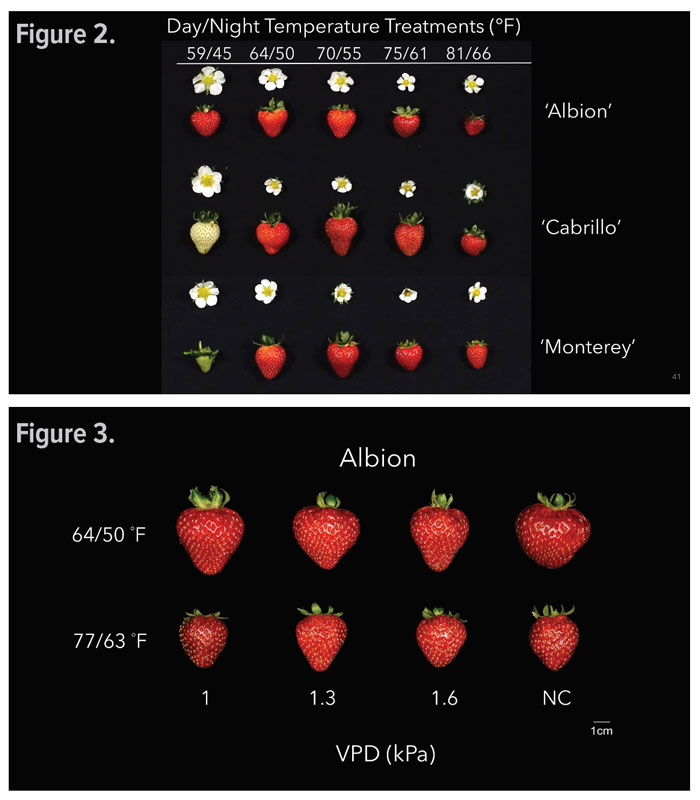
Figure 2 (top). Representative flowers and fruit of Albion, Cabrillo and Monterey grown at different day and night air temperatures for seven weeks.
Figure 3 (bottom). Fruit size of Albion grown at air day and night temperatures of 64/50F and 77/63F and under vapor pressure deficits (VPDs) of 1, 1.3, 1.6 or no VPD control (NC).
Water Stress for Most CEA Crops—High VPD (>1.3 kPa) A VPD greater than 1.3 kPa represents a relatively dry atmosphere, and water loss from leaves and the growing substrate increases as VPD rises (Figure 1). When VPD becomes high, plants must replace water lost through transpiration more rapidly. If the root system and substrate can supply water fast enough, plants can maintain normal stomatal function and photosynthesis. However, when atmospheric demand exceeds the plant's ability to replace lost water, stomata may partially close. This reduces water loss but also restricts carbon dioxide entry into the leaf. As a result, very high VPD can reduce photosynthesis, growth and productivity, particularly when it occurs simultaneously with high light, high temperature or inadequate substrate moisture.
These ranges should be considered guidelines rather than rigid targets. Crop species, developmental stage, canopy size, substrate moisture, light intensity, temperature and irrigation strategy all influence the VPD a crop can tolerate.
Why strawberries need more attention
Consumer demand for strawberries continues to increase and growers are expanding production in greenhouses and vertical farms to provide year-round local fruit. Despite this growth, relatively little research has examined how VPD affects strawberry production compared to other greenhouse food crops such as lettuce, tomatoes and peppers.
To address this knowledge gap, we evaluated the effects of average daily temperature (ADT) and VPD on plant growth, yield and fruit quality characteristics. The objective was to determine how ADT and VPD influence yield and identify potential optimum growing conditions for each cultivar.
The study
Bareroot plants of the everbearing cultivars Albion, Cabrillo and Monterey were transplanted into greenhouse substrate troughs. Once plants were established, troughs were placed in one of five greenhouse compartments with day/night (D/N) temperature set points (12 h/12 h) of 59/45F, 64/50F, 70/55F, 75/61F or 81/66F (15/7C, 18/10C, 21/13C, 24/16C and 27/19C) and average daily temperatures ranging from approximately 52 to 73F (11 to 23C). Air temperature, relative humidity and light intensity were recorded and monitored to calculate the daily light integral (DLI) and vapor pressure deficit (VPD). Supplemental LED lighting maintained a 16-hour photoperiod when natural light was insufficient. Harvesting occurred twice weekly over a 12-week production period and yield efficiency was calculated as weekly fruit production.
Temperature strongly influenced yield
The clearest finding was that temperature significantly affected strawberry productivity.
Across all three cultivars, yield followed a similar pattern. Production declined at both the coolest (59/45F) and warmest (81/66F) D/N temperatures (ADTs of 52 and 73F), while plants at the intermediate temperatures consistently produced the highest berries and yields (Figures 2 and 3). The optimum ADT for yield efficiency generally ranged from 63.7 to 65.5F (17.6 to 18.6C).
Although each cultivar responded differently, the overall trend was consistent. Moderate temperatures supported the greatest productivity, while extremes reduced berry size and yield.
We concluded that across cultivars, plants were most productive at D/N temperatures of 64/50F to 75/61F (18/10C to 24/16C) or ADT of 57 to 68F (14 to 20C), as this range balanced vegetative growth, flower development and fruit production.
VPD still matters—but perhaps less than expected
We observed that yield responded to VPD, but the relationships were generally weaker and less consistent than those for temperature. Optimum VPD values ranged from approximately 1.1 to 1.3 kPa, depending on cultivar (Figure 3). At extremely low (<0.5 kPa) and high (>2.0 kPa) VPDs, yields were consistently lower (Figure 4). This suggests that strawberries benefit from a slightly higher, more moderate transpiration environment compared to other greenhouse food crops. However, the magnitude of the VPD effect was smaller than that of temperature.
This led to one of the study's most important conclusions: Temperature appears to be a stronger determinant of strawberry productivity than VPD under the conditions tested.
 Why extreme VPD conditions reduce yield
The physiological explanations behind these responses are consistent with previous crop research. At elevated VPDs, plants experience greater transpiration demand. If water loss exceeds the root system's ability to supply water, stomata begin to close. This limits carbon dioxide uptake, reduces photosynthesis and can ultimately slow fruit growth, development and yield. In addition to leaf physiology, strawberry flower development is particularly sensitive to VPD. High VPD can directly reduce pollen viability and flower size, and previous research has shown that smaller flower size often leads to lower fruit size and overall yield.
Figure 4. Yield efficiency in kg/trough/week of Albion, Cabrillo and Monterey under a range of vapor pressure deficits.
Similarly, low VPD environments can also reduce plant growth, development and yield. Under these conditions, transpiration rates decline, slowing nutrient transport and potentially affecting plant development. Excessively humid environments may also increase disease pressure, reducing leaf photosynthesis and marketable yield of berries.
Practical implications for growers
What does this mean for commercial greenhouse and indoor farm operators? First, temperature management should remain a primary focus as discussed in Article 1. While VPD monitoring provides valuable information, growers should ensure that temperature setpoints are optimized before investing heavily in advanced humidity-control strategies.
Second, maintaining moderate VPD levels is important. Growers should continue targeting moderate transpiration conditions while avoiding excessively humid (<0.7 kPa) or dry (>2.0 kPa) environments.
Third, cultivar-specific responses deserve less consideration for VPD control than temperature control. In this study, all three cultivars responded similarly to VPD (Figure 4).
Finally, growers should remember that VPD and temperature are inherently linked. As temperature increases, VPD typically increases as well. This relationship makes it difficult to entirely separate the effects of the two variables in commercial production environments.
The bottom line
VPD remains an important environmental metric because it influences transpiration, nutrient uptake, photosynthesis and plant water relations. For growers producing everbearing strawberries, the most productive environment appears to be one that combines moderate temperatures with moderate VPD conditions. However, this research also suggests that temperature may have a greater impact on strawberry yield than VPD alone.
As the industry continues to refine production practices, these findings provide a reminder that successful controlled environment strawberry production requires more than optimizing a single environmental metric. IG
Roberto Lopez is an Associate Professor and Controlled Environment Extension Specialist; Joshua Vander Weide is an Assistant Professor and Berry Crop Extension Specialist; Pin-Jui Chen is a PhD student; and Nick Cooley is a research technician in the Department of Horticulture at Michigan State University. The authors gratefully acknowledge the USDA Hatch Multistate Fund and the USDA National Institute of Food and Agriculture Hatch project nos. MICL02472 and MICL02828 for funding.