4/30/2026
Beyond Lettuce Greens
David Kuack

When it comes to controlled environment vegetable crops, leafy greens are typically the crop most growers start with. But what if growers want to expand their product mix? What options do they have?
It’s nuanced because there are opportunities around holidays that involve large meals, like Thanksgiving and Easter, but Joe Swartz, senior vice president of American Hydroponics, said he often sees leafy greens growers trying to expand their product mix without working closely with their local markets on their needs.
Area 2 Farms’ CSA customers receive five different vegetable items every week, including a salad greens mix, microgreens, an herb, a root crop and a specialty item. | Photo courtesy of Tyler Baras, Area 2 Farms
Joe said growers need to develop a close personal relationship with their market customers to make this work. He said it’s been much easier to tailor some of his company’s production to community supported agriculture (CSA) and online customers. The big eating holidays—including Thanksgiving, Christmas and Easter—are ones for which he produces seasonal crops.
“Surprisingly one event we have had good success with is Kentucky Derby Day,” he said. “Almost every bar is looking for fresh mint for the drinks they will be serving their customers.
“Local holidays and events are smaller in scale, with limited production, but still good options for leafy greens growers. One of the big draws of CEA is a consistent production level. If growers try to change their crop model just to fit into a specific holiday that tends to be more difficult.”
 Don’t overlook cultural, ethnic markets
While the demand for specialty crops is often driven by seasonality and climate, Joe said more demand is the result of market demographics.
“In parts of New York, there are large Brazilian populations,” he said. “We have shifted some of our production to amaranth greens (Amaranthus viridis, A. dubius) which are used to make callaloo, a popular Caribbean dish. Amaranth greens are used in Caribbean, Brazilian and Jamaican cooking.
Area 2 Farms produces a shamrock microgreen mix, which includes a purple shamrock (Oxalis triangularis) that looks like clover and has a citrusy taste. | Photo courtesy of Tyler Baras, Area 2 Farms.
“Growing amaranth greens in a CEA facility under favorable growing conditions, manipulating the environment and fertilization, and harvesting the crops at a much younger stage produces high quality, tender greens. In most parts of the country, the only amaranth greens that are available, if they’re available at all, are over mature, fibrous and low quality. It is a controlled environment crop that markets are willing to pay for because it is a much higher quality product that consumers usually aren’t able to buy.”
Even though there may be a demand for a certain crop, Joe said this doesn’t necessarily mean there’s a high market demand.
The demand is going to depend on the market demographics, so it’s beneficial to understand the customer base around your area and the recipes that are popular within those cultures. Joe said consumers are generally willing to pay more for these hard-to-find, high-quality specialty crops.
“What we have seen with ethnic specialty crops is these are grossly underserved markets,” he said. “In some of these communities, [they] prepare very specific cultural or ethnic foods and the only available version of these crops is very poor quality. We have seen buyers and end users who are willing to pay for good quality versions of some of these crops.”
 Direct to consumer sales
Area 2 Farms, a controlled environment vertical farm in Arlington, Virginia, grows a lot of seasonal crops. Its crops are primarily scheduled around holidays or its customers’ emotional response to what they expect for a specific season, including edible flowers in the spring and stewing greens during the winter. Area 2 Farms focuses primarily on community supported agriculture (CSA) with nearly 300 members.
“Our market is divided into four seasons,” said Tyler Baras, co-founder and chief science officer at Area 2 Farms. “We produce specific salad greens, microgreens, herbs and root crops for each of the different seasons. Our production system is soil-based, but other CEA growers could produce root crops in hydroponic systems. Using a soil-based system makes it easier to produce root crops including turnips, radishes, carrots, onions and leeks.”
Production systems designed for growing leafy greens and herbs, including nutrient film technique (NFT), deep water culture, and flood-and-drain systems, can be adapted to produce other specialty crops. | Photo courtesy of Joe Swartz, American Hydroponics.
Area 2 Farms’ customers receive five different vegetable items every week. Products include a salad green mix, microgreens, an herb, a root crop and a specialty item.
“The specialty item could be a cocktail mix that we grow for New Year’s and the Fourth of July,” Tyler said. “We have grown a rosemary tree for the Christmas holiday. For our salad greens, we may grow greens with a more citrusy flavor, including sorrel, for our spring and summer mixes. In fall and winter, we switch to herbs and greens that consumers tend to use in cooking or stir fry, including kale, bok choi and hardier greens.”
Since many of Area 2 Farms’ customers are gardeners, the company began producing and selling transplant seedlings.
“As our customers were getting ready to garden in the spring, they didn’t want us to produce harvested basil,” Tyler said. “But they did want basil seedlings to plant in their own gardens. CEA growers, whether growing in a greenhouse or vertical farm, could easily produce transplants for consumers and other commercial growers. Seedling transplants was one crop that came from just knowing what our customers wanted.”
It takes practice to grow specialty crops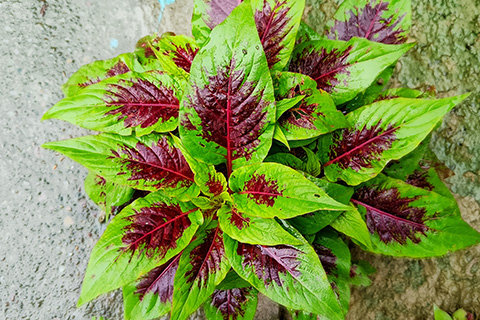
Tyler said the production systems used to grow leafy greens and herbs, including nutrient film technique (NFT), deep water culture, and flood-and-drain systems, can be adapted to produce other specialty crops, but unlike leafy greens, some of the specialty crops take longer to learn how to grow.
Amaranthus greens (Amaranthus viridis, A. dubius) are used in Caribbean, Brazilian and Jamaican cooking.
For example, rosemary may be grown only once a year, which is going to slow down the learning process. “The crops that require some of the biggest adjustments are those that require different propagation methods and irrigation,” Tyler said. “This would include woody herbs, including rosemary and thyme. We produce an herb bundle for Thanksgiving week that includes rosemary, thyme, oregano and instructions on how to use this mix for when preparing a turkey. These are three fairly challenging herbs if a grower is just producing leafy greens.”
Because these herbs are typically produced from cuttings, growers may not have the proper production system for growing crops other than from seed.
“Growers would have to produce their own cuttings or buy in cuttings from another source,” Tyler noted. “If the cuttings are sourced, growers may not have brought in plant material before, which can bring a whole new set of challenges, including potential pests and diseases coming in on the cuttings. Irrigation for these herbs also has to be adjusted because these plants don’t like a wet substrate like leafy greens.”
Another major issue growers need to be aware of with some of these specialty crops is shelf life related to postharvest.
“Some of the ‘fun’ specialty crops very often for us have the worst shelf life,” Tyler said. “We quickly learned why some of these crops are not produced on a large commercial scale.
“In spring, we grow a shamrock microgreen mix, which includes a purple shamrock (Oxalis triangularis) that looks like clover and has a citrusy taste. We combine the shamrock with some broccoli microgreens. This mix tastes amazing, but purple shamrock has a very short shelf life, which could shock some leafy greens growers.”
Even though some specialty crops like basil may have a longer shelf life, leafy greens growers need to know how to store the harvested crop.
“Leafy greens growers are used to putting harvested crops into a cooler,” Tyler said. “Basil can’t be stored in temperatures below 50F or the leaves turn brown. Leafy greens growers looking to add some of these specialty crops may need to be thinking about new postharvest and storage methods.”
Building a network of growers
Area 2 Farms is building a network of growers to share its resources, production system methods and crop growing information. The company is opening a second production operation in Fairfax, Virginia.
“Instead of having to do all of the trialing to determine what are good varieties, what are some of the postharvest issues, we provide growers with a grow book for all of these crops,” Tyler said. “This makes it far less daunting for growers who want to constantly grow new releases to keep their product mix fresh. Instead of trying to figure out all of the production information on their own, we are sharing some of the same seeds and crop recipes.”
Area 2 Farms is marketing its production system, which has application in vertical farms and greenhouses.
“The soil-based production system we are using now is in a vertical farm,” Tyler said. “Like other hydroponic systems including NFT, our production system has application in greenhouses as well.” IG
David Kuack is a freelance technical writer in Fort Worth, Texas. Email him at dkuack@gmail.com.