10/30/2026
The Language Gap in Substrate Science
Brandan A. Shur
As the old joke goes, a grower, a substrate manufacturer and a researcher all walk into a bar. Maybe not an old joke—but ask the three to describe the same root zone and you may get three different vocabularies.
The grower might squeeze a handful of substrate and say, “This one stays too wet.”
The manufacturer may call it a high-porosity mix.
And the researcher may start asking about bulk density, air-filled porosity, container capacity and the water-retention curve.
They may be describing the same concern—or different physical properties. That’s where substrate language gets confusing. Different words can describe the same idea, while the same word can mean different things.
I move between those worlds often. My training centers on substrate hydrophysical properties and root-zone management, but greenhouse conversations describe the same behavior differently than research papers do. One of the biggest gaps in substrate science may simply be language.
The issue is real enough that substrate researchers have published an updated glossary in Acta Horticulturae, a publication for the International Society for Horticulture Science, to clarify terms and the characteristics that should be reported. Even specialists occasionally have to stop and make sure we mean the same thing.
What do we call the root zone?
 Even the word “substrate” can start a discussion. In commercial horticulture, we hear substrate, growing medium, growing media, media, potting mix and sometimes potting soil used for roughly the same thing.
I generally use “substrate” for a selected or manufactured root-zone material in soilless production. “Growing medium” is also accepted; “medium” is singular and “media” plural, though “media” is common industry shorthand. “Potting soil” is less precise when little or no mineral soil is present.
Then there’s “hydroponics.” In industry, the word may describe everything from nutrient film technique (NFT) to crops rooted in coir or rockwool and fertigated with nutrient solution. Scientific usage varies, too, so the word alone doesn’t always tell you whether a root-zone substrate is present.
The point isn’t to be the vocabulary police; it’s to make the production system clear before we compare results, recommendations or products.
Porosity is not one number
“High porosity” is another phrase we hear often and it sounds more specific than it really is. Total porosity is the fraction of substrate volume occupied by pores rather than solid material. Those pores may contain water, air or both. A substrate can therefore have high total porosity while still having relatively little air-filled porosity after irrigation and drainage.
Air space, or air-filled porosity, describes the fraction of substrate volume occupied by air at a defined moisture condition. Container capacity is the water retained after saturation and drainage in a container or test sample of defined height under a defined method. Together, these measurements describe how pore space is partitioned between water and air.
So “porous” isn’t enough. Are we talking about total pore volume, air space after drainage or pores that retain water? Those distinctions can change how we irrigate and how roots perform.
 The container changes the answer
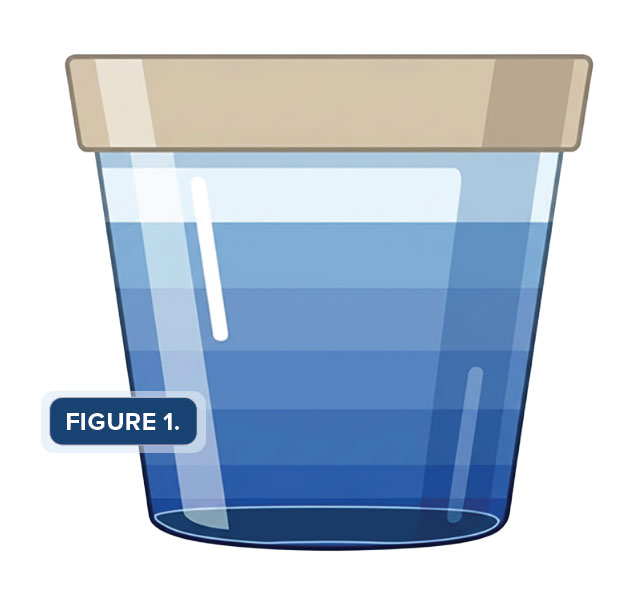
Here’s where gravity enters the conversation. Water is pulled downward by gravity while capillary forces retain it within pores and along substrate surfaces. After irrigation and drainage, that balance creates a moisture gradient. In a uniform substrate profile, the lower portion generally remains wetter, while water content decreases and air-filled pore space increases with height.
Now put the same substrate into two containers with different heights. In a short propagation cell, a greater proportion of the root zone can sit within that relatively wet lower region. In a taller container, more substrate extends above it, where water content is lower and air-filled pore space is greater after drainage.
Nothing magical happened to the peat, bark, coir or perlite. The container changed the way water was distributed through it.
After irrigation and drainage, a uniform substrate profile isn’t uniform in water content (Figure 1). The lower portion generally remains wetter, while water content decreases and air-filled pore space increases with height. The exact distribution depends on the substrate, container geometry and measurement conditions.
That’s why water-holding and air-space values need context. What method was used? What was the sample height and packing? At what pressure or suction was it measured? Was it characterized in a laboratory cylinder or the production container? A number without a method can create almost as much confusion as having no number at all.
“Water-holding” is only the beginning
Water-holding capacity is useful language, but it can hide important details. A substrate may retain a large volume of water without all of that water being equally easy for roots to extract. Researchers may partition retained water into fractions, such as easily available water-using retention curves and defined tension ranges. Growers see the same physics more practically: container weight, irrigation frequency, drying uniformity and crop response late in an irrigation cycle.
Wettability adds another layer. A substrate that retains water well once wetted may become difficult to rewet after excessive drying. Water retention and rewetting are related, but they aren’t the same property.
And "drainage" may be the most overloaded word of all. When someone says, "This substrate drains fast," what are they observing? Water exiting the bottom quickly? The pot losing weight quickly? The lower root zone avoiding saturation? High air space? Or simply a crop that performs well under their irrigation program?
All are useful observations, but they aren’t the same measurement. Hydraulic conductivity describes how readily water moves through a substrate under defined moisture conditions; it’s different from how much water the substrate stores. Drainage rate isn’t synonymous with air space, and high air space doesn’t automatically mean poor water availability.
If a crop stays too wet, changing the substrate isn’t always the answer. Container geometry, irrigation volume and frequency, and handling may matter just as much.
Density, particles and the way we fill
Bulk density sounds like laboratory vocabulary, but growers influence it every time a container is filled. Dry bulk density relates the dry mass of substrate to its bulk volume under defined conditions. Fill two pots with the same substrate but compact one more firmly and the ingredient list hasn’t changed. The physical architecture has. Packing changes particle and pore arrangement and can alter air/water relationships. Even a few taps on the bench can influence bulk density.
The same caution applies to particle size. “Coarse” and “fine” are useful descriptions, but particle size isn’t pore size. The pore network that governs water and air occurs between particles and, for some materials, within the particles themselves. Particle size, shape, internal porosity, arrangement and packing all help determine that network.
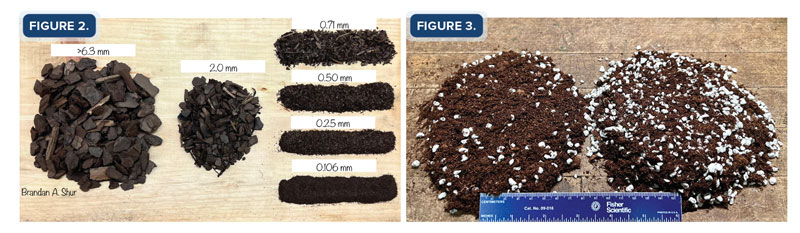
Words such as “coarse” and “fine” are useful shorthand, but they become more meaningful when tied to measured particle-size distributions (Figure 2). Particle size can influence substrate structure, but particle size and pore size aren’t interchangeable because pore architecture also depends on particle shape, arrangement, internal porosity and packing.
Fibrous wood, bark and perlite particles of similar dimensions don’t necessarily create the same pore architecture. This is why an ingredient list cannot predict performance by itself. Peat, coir, bark, wood fiber, perlite and vermiculite are categories, not uniform materials. Source, grade, processing, particle characteristics and handling all matter.
Two substrate blends can contain similar ingredient categories and still differ substantially in proportions and particle architecture (Figure 3). Ingredient lists are useful, but measured physical properties provide the context needed to interpret water and air behavior and to develop management recommendations.
Translating words into growing decisions
None of this means a grower saying, “This mix stays too wet,” is using bad terminology. In fact, that observation may be the most useful place to begin. The next step is translation.
Is the substrate retaining more water following irrigation? Is air-filled porosity limited in that particular container? Is the irrigation volume too high or the interval too short? Has the substrate settled or compacted? Is the lower root zone staying wet while the upper portion is already dry? Is the real problem uneven wetting or poor rewetting? Those questions lead to very different management decisions.
Scientists have the same responsibility in reverse. A laboratory value becomes useful only when we connect it to irrigation, rooting, crop performance and the production system in which the substrate is used.
Even “dry-back,” a term used constantly in controlled environment production, benefits from the same discipline. A “20% dry-back” sounds precise, but 20% of what? Is it a 20-percentage-point decrease in volumetric water content, a 20% relative change from the starting value, a change in container weight or a sensor-specific output? Over what period, and where in the root zone was it measured? Those values aren’t necessarily interchangeable.
Breaking it down
Here are four questions worth asking when comparing substrate specifications or troubleshooting a crop:
- What property are we actually describing?
- How was it measured?
- In what container and under what handling or packing conditions?
- What does that property mean for how I need to manage the crop?
Those questions turn vocabulary into decisions.
The goal isn’t to make greenhouse conversations sound like scientific manuscripts or replace grower observations with laboratory numbers; it’s to connect the two. Growers often describe the crop response. Researchers often describe the mechanism underneath it. Manufacturers have to translate both into products that perform consistently.
If we can speak enough of the same language to connect those pieces, terms such as porosity, drainage, water-holding capacity and dry-back become more than labels on a specification sheet. They become tools for choosing substrates, setting irrigation strategies and diagnosing problems.
A shared vocabulary won’t make every substrate behave the same. But it can make it much easier to know whether the next thing to change is the substrate, the container and the irrigation strategy—or simply the way we’re describing the problem. IG
Brandan A. Shur is a Ph.D. researcher focusing on controlled environment agriculture (CEA) and plant pathology at Virginia Tech University in the School of Plant and Environmental Sciences.