4/30/2026
The Impact of Night Interruption Lighting on Strawberries
Roberto Lopez, Sean Tarr, Jared Zaporski & Josh Vander Weide
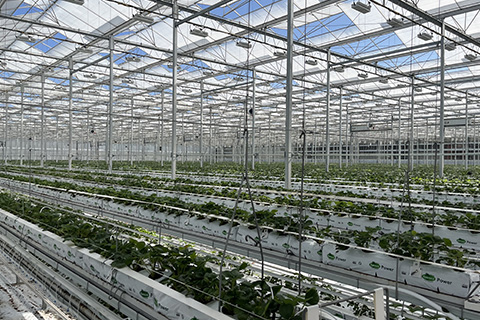
Globally, strawberries are among the most economically significant berry crops. While field production still dominates, protected cultivation in high-tunnels, greenhouses and indoor farms is rapidly increasing, particularly in latitudes above 40˚N where high-quality fruit for fall, winter and spring markets can create premium pricing opportunities (Figure 1). In these systems, temperature management is often achievable due to favorable outdoor temperatures, but natural light levels and daylength during the winter months are suboptimal to sustain flowering and fruiting yields, which necessitates supplemental lighting.
Figure 1. Greenhouse production of everbearing strawberries.
The classification of strawberries as short-day (June-bearing) or day-neutral (everbearing) types has shaped grower decision making for decades. Flower bud initiation of short-day cultivars occurs when daylengths are below a critical threshold of approximately 12 hours. In contrast, everbearing cultivars are often described as insensitive to photoperiod and capable of flowering continuously under favorable temperatures outlined in our first article. However, this description is overly simplistic. Most everbearing cultivars are not photoperiod-insensitive; rather, they’re facultative (quantitative) long-day plants and can flower under a range of daylengths. However, flowering is accelerated and yield is substantially enhanced under long-day conditions.
Why photoperiod matters
This distinction carries major implications for winter greenhouse production of everbearing cultivars in controlled environments. In northern latitudes, natural daylengths during late fall and winter range from nine to 11 hours. Under such conditions, everbearing cultivars may eventually flower, but reproductive development is slower, truss initiation is reduced and fruit number declines. Commercial growers typically compensate by extending the daylength to 15 or 16 hours. However, this requires growers to light the crop for five-plus hours after sunset to achieve the desired daylength. While effective biologically, this strategy is energy intensive and costly.
Night interruption (NI) lighting offers a fundamentally different approach to manipulating daylength, both indoors and in the field. Instead of extending the daylength with day extension (DE) lighting to create a continuous 15- to 16-hour day, growers provide low-intensity photoperiodic lighting in the middle of the natural dark period. Therefore, long-day plants perceive exposure to four hours of light during the night as a physiologically long day. This principle has been widely used in floriculture crops, but has received less attention in fruiting crops such as strawberries.

Figure 2. Everbearing strawberry Albion grown under a 10- 11-, 12-, 13-, 14-, 15- or 16-hour photoperiod or a four-hour night interruption from 10:00 p.m. to 2:00 a.m.
Study details
Four everbearing cultivars—Albion, Mara Des Bois, San Andreas and Seascape—were grown in a glass-glazed greenhouse under a day/night temperature of 77/67F, and one of seven photoperiod treatments (10, 11, 12, 13, 14, 15 or 16 hours) or an NI treatment. The NI treatment consisted of a nine-hour photoperiod, followed by four hours of low intensity light delivered from 10:00 p.m. to 2:00 a.m. using horticultural light-emitting diode (LED) fixtures that provided 2 to 3 μmol∙m–2∙s–1 of red, far-red and white light. Despite this minimal intensity, the biological response was substantial.
Long-day response was cultivar specific
We found that most cultivars tested require at least 15 hours of light to maximize flowering and yield under DE lighting. For example, the fruit number or total fruit mass of Albion, San Andreas and Seascape did not increase until they were exposed to 15 or 16 hours of light (Figures 2, 3 and 4).
It’s important to note that cultivar differences were evident. Mara Des Bois displayed a somewhat lower critical photoperiod than the other cultivars, responding positively at 13 to 14 hours, indicating it has a somewhat weaker long-day requirement. Nevertheless, under longer daylengths it exhibited improved performance. Albion, San Andreas and Seascape exhibited stronger long-day characteristics and required longer perceived photoperiods (Figures 2, 3 and 4). Growers should therefore consider small-scale trials when adopting NI strategies, particularly when working with diverse cultivar portfolios.
The study also highlights that everbearing strawberries are best described as facultative long-day plants rather than truly day neutral. The term “remontant,” often used in breeding literature, may more accurately capture their repeat-flowering habit without implying photoperiod insensitivity. Recognizing this biological reality enables growers to optimize environmental control strategies more precisely.
The mechanism underlying this response is rooted in photoperiodic regulation of flowering. In long-day plants, flowering is promoted when the dark period falls below a critical length. By interrupting the night, even briefly, the plant’s internal photoreceptors perceive a long day. This accelerates floral initiation and increases the number of reproductive structures formed.

Figure 3. Everbearing strawberry San Andreas grown under a 10- 11-, 12-, 13-, 14-, 15- or 16-hour photoperiod or a four-hour night interruption from 10:00 p.m. to 2:00 a.m.
Photoperiod and NI strongly affected phenology and yield potential
Time to first flower was strongly influenced by photoperiod. In several cultivars, exposure to NI lighting reduced the time to flower by approximately 24 to 26 days compared with plants under the 13-hour photoperiod (Figures 2, 3 and 4). In practical terms, flowering occurred nearly four weeks earlier. Earlier flowering translated directly into higher cumulative fruit production over the harvest window. In San Andreas, plants under the 13-hour treatment failed to flower within the study period, whereas those under NI flowered and fruited successfully (Figure 3).
What makes the findings particularly compelling are the results from our NI treatment. Although NI lighting was physiologically equivalent to a 13-hour photoperiod of total light hours, it dramatically outperformed it. Under 13 hours of uninterrupted light, several cultivars produced little to no fruit. Under NI lighting, those same cultivars flowered earlier and produced fruit yields comparable to or exceeding those observed under a 16-hour photoperiod.
Yield improvements were primarily driven by increases in fruit number rather than by increases in average fruit size. Under longer daylengths and NI lighting, plants produced more trusses and, in some cultivars, more fruit per truss. The increase in reproductive structures created a stronger sink for carbohydrates, shifting the plant’s source–sink balance toward fruit production. Foliage mass changed relatively little compared to total fruit mass, meaning that the ratio of reproductive to vegetative growth increased substantially under long-day and NI treatments.
A strong negative correlation was observed between time to flower and the fruit-to-foliage mass ratio. The earlier a plant initiates flower buds, the greater its allocation of biomass toward fruit. This reinforces a key production principle: accelerating reproductive development early in the crop cycle enhances overall yield potential.
Although NI lighting proved to be effective in this study, only a single NI duration and spectral composition were evaluated. Photoperiodic responses are also influenced by light quality, timing and duration. Further research may identify even more energy-efficient NI regimes. Nonetheless, the consistent response across cultivars in this trial provides strong confidence in the approach.
Another important point to note is that low-intensity lighting does not provide photosynthetic light to increase yields when the photosynthetic daily light integral (DLI) is low. In these situations, high-intensity supplemental lighting from high-pressure sodium (HPS) lamps or high-intensity LED fixtures should be used to extend the daylength and provide photosynthetic light to increase yield.
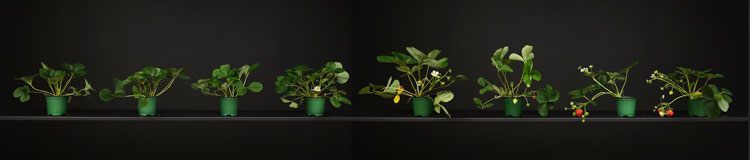
Figure 4. Everbearing strawberry Seascape grown under a 10- 11-, 12-, 13-, 14-, 15- or 16-hour photoperiod or a four-hour night interruption from 10:00 p.m. to 2:00 a.m.
NI could reduce electricity usage
From an operational standpoint, the energy implications are significant. Compared with DE lighting providing a 16-hour day photoperiod, NI lighting reduced energy consumption by three-plus hours per day with low-intensity LED lamps. Furthermore, because the interruption occurred between 10:00 p.m. and 2:00 a.m., energy use could potentially be shifted to off-peak utility hours, when electricity rates are often lower. While the study did not include a formal economic analysis, the biological data strongly suggest that NI can deliver equivalent yield with substantially reduced energy input.
As electricity prices remain volatile and sustainability considerations become increasingly important, production strategies that maintain yield while reducing electrical demand will become essential. For commercial greenhouse strawberry operations targeting winter and early spring markets, the implications are clear. Natural short days are insufficient to maximize yield in most everbearing cultivars. Providing a 16-hour photoperiod is effective, but expensive. Night interruption lighting offers a biologically sound and potentially cost-saving alternative. By leveraging the plant’s inherent photoperiodic mechanisms rather than simply increasing the number of hours plants receive light, growers can achieve long-day responses with fewer inputs.
Practical takeaways
Cultivar selection matters. Most everbearing strawberry cultivars tested respond strongly to photoperiod manipulation, exhibiting facultative long-day responses. However, one cultivar had a weaker long-day requirement.
Long days were required for fruit production. At least 15 hours of light was required to maximize flowering and yield under day extension lighting. A longer photoperiod impacted flower and fruit number per plant more than fruit size.
NI lighting mimicked long days. NI lighting advanced flowering by several weeks and produced yields comparable to a 16-hour photoperiod, while using less energy. For strawberry producers seeking both biological performance and economic efficiency, NI lighting deserves serious consideration as a replacement for traditional DE lighting strategies. IG
Roberto Lopez is an Associate Professor and Controlled Environment Extension Specialist, Sean Tarr and Jared Zaporski are research technicians, and Joshua Vander Weide is an Assistant Professor and Berry Crop Extension Specialist in the Department of Horticulture at Michigan State University. The authors gratefully acknowledge the USDA Hatch Multistate Fund, USDA National Institute of Food and Agriculture Hatch project nos. MICL02472 and MICL02828 for funding.