4/30/2026
Four Steps for Protecting Herbs
Dr. Raymond A. Cloyd
Herbs are grown in greenhouse production systems as potted plants or in water-based nutrient solutions (hydroponically). Herbs grown in greenhouse production systems include basil, catnip, cilantro/coriander, dill, lavender, marjoram, mint, oregano, parsley, rosemary, sage and thyme. Depending on the type, herbs can vary in their susceptibility to insect and/or mite pests, including aphids, caterpillars, fungus gnats, mealybugs, shore flies, thrips (e.g. western flower thrips), mites (e.g. two-spotted spider mite) and whiteflies.
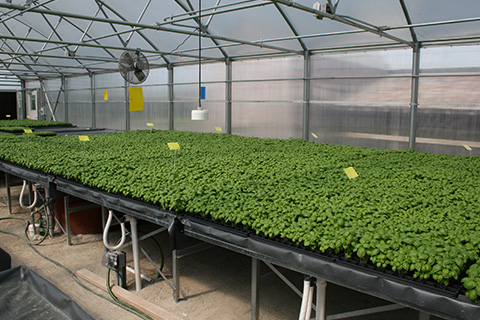
Figure 1. Yellow sticky cards placed among a basil crop.
Managing insect and mite pests on greenhouse-grown herbs is a challenge because pesticides (insecticides and/or miticides) labeled for use on greenhouse-grown horticultural crops (e.g. bedding plants and perennials) are generally not labeled for use on greenhouse-grown herbs because herbs are a consumable crop. There are, in fact, few pesticides (insecticides and/or miticides) labeled specifically for use on herbs. Hence, applying pesticides may not be an option. However, there are plant protection strategies that greenhouse producers can implement to mitigate problems with insect and/or mite pests, including scouting, trapping, sanitation and screening.
Scouting
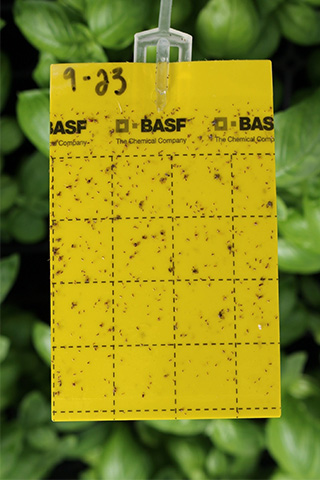
Scouting is a procedure designed to determine the trends associated with insect or mite pest populations throughout the growing season and detect pest presence early in the herb production cycle so that the appropriate plant protection strategy can be implemented in a timely manner. Scouting involves placing yellow sticky cards throughout the greenhouse production area (Figure 1) and visually inspecting herb crops on a regular basis (e.g. once per week). Yellow sticky cards are used to capture the adult life stages of fungus gnats, moths, shore flies, thrips and whiteflies (Figure 2).
One yellow sticky card should be placed in every 500 sq. ft. of greenhouse space and be equally distributed throughout the greenhouse. In addition, yellow sticky cards should be placed near openings, such as vents, sidewalls and doors to capture insect pests entering the greenhouse from outside or from other greenhouses.
 Check yellow sticky cards once per week and count the number of captured insect pests. Conduct visual inspections to detect mealybugs, mites and non-winged aphids on herb crops, as well as eggs, larvae, nymphs and pupae of moths, thrips, whiteflies. Be sure to inspect leaf undersides where mites, mealybugs and other life stages are located. Maintain records on when insect and/or mite pests are present during the growing season and what herb crops are affected by insect and/or mite pests.
Figure 2. A closeup on a yellow sticky card showing capture of the adult stages of insect pests.
Trapping
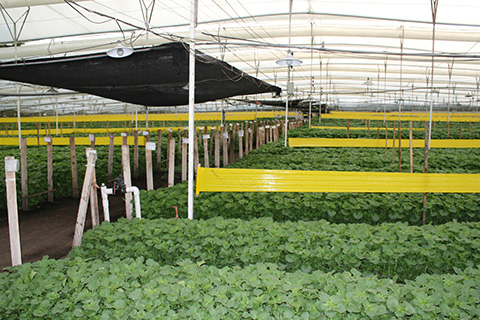
Trapping involves placing yellow sticky tape throughout the greenhouse (Figure 3) above herb crops to capture adults of fungus gnats, shore flies, thrips and whiteflies. Trapping can reduce the number of insect pests in subsequent generations, thus decreasing damage to herb crops during the growing season. Trapping efficiency can be maintained by replacing yellow sticky tape twice during the growing season as glue stickiness declines over time.
Sanitation
Sanitation entails keeping the greenhouse clean by removing weeds and disposing of plant and growing medium debris. Weeds should be removed from within and around the greenhouse perimeter because weeds such as dandelion, nightshade, oxalis, pigweed and sowthistle can harbor insect pests, including aphids, thrips and whiteflies, and the viruses vectored by these insect pests. For example, certain herbs, such as basil, catnip and coriander, are susceptible to Tomato Spotted Wilt Virus (TSWV) or Impatiens Necrotic Spot Virus (INSV), which are vectored by thrips. In addition, weeds may provide overwintering sites for certain insect and/or mite pests. Also, thrips and whiteflies can enter greenhouses from weeds located outside openings, including vents, sidewalls and doorways. Weed-free areas around the outside perimeter of greenhouses (10 to 20 ft.) can reduce adult thrips from entering greenhouses through openings, thus decreasing the incidence of virus transmission.
Figure 3. Yellow sticky tape placed above an herb crop will capture the adult life stages of insect pests.
 Plant debris may harbor insect pests and should be removed from the greenhouse to prevent insect pests from infesting herb crops. Growing medium debris may provide habitats for fungus gnats and thrips to pupate. Consequently, growing medium debris should be removed from greenhouses. Place plant and growing medium debris into refuse containers with tight sealing lids or immediately remove from greenhouses. Plant and growing medium debris can harbor insect pests, such as fungus gnats, thrips and whiteflies, and should be placed into sealed refuse containers to prevent winged adults from moving out of the containers and onto herb crops. A broom or shop vacuum can be used to remove plant or growing medium debris. Furthermore, remove or dispose of old stock plants or those remaining at the end of the growing season because they may harbor insect and/or mite pests, and the viruses transmitted by thrips.
Finally, remove herbs that are infested with insects or mites. Place infested plants into a plastic bag and dispose of immediately.
 Screening
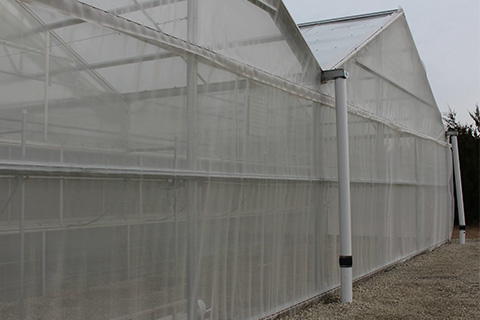
Insect exclusion screening can be installed over greenhouse openings (Figure 4) to prevent adult thrips from entering greenhouses from outside sources. Restricting the entry of thrips adults into greenhouses protects herb crops from the viruses transmitted by thrips. The mesh size of insect exclusion screening for thrips is 192 microns or 76 mesh. Insect exclusion screening installed over greenhouse openings can prevent thrips adults from entering greenhouses from field-grown crops, such as corn, soybean or vegetables. Insect exclusion screening can also prevent weed seeds from entering greenhouses, which will mitigate problems with weed seeds establishing in the growing medium of potted plants.
Figure 4. Insect exclusion screening can be installed over greenhouse openings to prevent adult thrips from entering.
Insect exclusion screening may be too expensive for some greenhouse operations. Furthermore, there are issues associated with an increase in temperature and relative humidity in greenhouses because insect exclusion screening can restrict airflow.
Conclusion
It’s important to protect herb crops from insect and/or mite pests by implementing the plant protection strategies outlined in this article—scouting, sanitation, trapping and screening—which will help to keep insect and/or mite pest populations below plant-damaging levels. IG
Dr. Raymond A. Cloyd is a Professor and Extension Specialist in the Department of Entomology at Kansas State University in Manhattan, Kansas. He can be reached at (785) 532-4750 or rcloyd@ksu.edu.