4/30/2026
A Strategy of Change
Chris Beytes
CEA startup BrightFarms first came to our attention back in 2012 with this audacious headline: “World’s Largest Rooftop Farm Planned for Brooklyn, Making New York the Model for Urban Agriculture”.
Then there were quotes from founder Paul Lightfoot like this one: “Our mission is simple: get local produce to local people, faster, fresher, and more sustainably. If we can do that on rooftops, in parking lots or even in former warehouses, we’ve shown a new way to farm.” The mission of the time said that greenhouses “would be located within a few miles of major supermarkets, allowing produce to go from greenhouse to shelf in under 24 hours.”
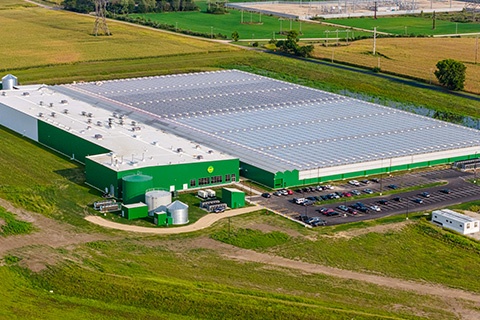
The new model for BrightFarms: 8 acres of Kubo Ultra-Clima greenhouse, scalable to 32 acres. This happens to be Illinois; Georgia looks just the same but with the addition of the Cox Farms’ Discovery Center. (We weren’t permitted to take aerial photos because there’s an airport right next door.). Note the relatively few roof vents, a tell-tale sign of a semi-closed greenhouse. | Photo courtesy of Bright Farms
Alas, that Brooklyn rooftop greenhouse never materialized. And the business model of hyperlocal production only lasted a very short time. And yet, 14 years later, BrightFarms has evolved into a powerhouse of hydroponic lettuce production, pivoting from the impractical dreams of urban rooftops, to inefficient mid-sized peri-urban greenhouses, to large, scalable regional hubs that optimize growing along the same lines of what successful vine-crop CEA operations in the Netherlands and Canada have been doing for generations. Founder Paul Lightfoot was not afraid to adjust his strategy as he learned the business, and new owner (as of 2021) Cox Farms, a division of the Cox Enterprises multimedia conglomerate, has invested many millions of dollars in the belief that BrightFarms can become a major player in the North American greenhouse lettuce scene.
Being flexible rather than riding a flawed concept all the way to Chapter 11 (as so many others have done) is one of the reasons our Cultivating Excellence Award judges selected BrightFarms as our 2026 Operational Excellence winner. Because BrightFarms’ long-standing goal hasn’t changed: Build a nationwide network of local hydroponic greenhouses that supply supermarkets with fresh greens grown close to consumers, replacing the long-distance produce supply chain.
Even if the definition of “local” has moved from the supermarket rooftop to several states away.
What makes BrightFarms tick?
To learn more, we caught up with Executive Vice President of Operations Eric Dobbins via Microsoft Teams at his home base in St. Louis. Eric’s background pleased us; he’s not a Silicon Valley tech guy—he grew up on a family cattle ranch and barley farm in Washington State (“I was one of those farm kids,” he admitted with a laugh), so he knows and respects traditional agriculture. Plus, he did stints with Monsanto and Bayer before joining BrightFarms in 2024, so he knows Big Ag isn’t the enemy.
 We asked Eric how he’d describe the core operating philosophy of BrightFarms today compared to when BrightFarms got started 15 years ago.
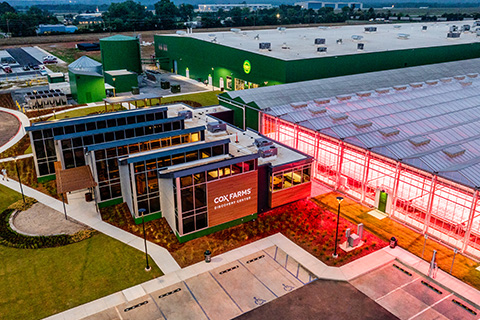
The Cox Farms Discovery Center is designed as a gathering space for vendors, customers, visitors and tour groups. Photo courtesy Bright Farms
“The philosophy, or the core mission and vision, are still very similar,” he answered. “It’s all about providing really fresh produce to people. It’s a bit more regional today than being on a rooftop in a city. But it has to be scalable. The company learned that along the way. It’s really, really difficult to go to that rooftop and make a profit, because you’re so small. You got to scale things, you got to have growers who can do this really, really well. You got to have folks that can do all the packaging and the food safety and everything else that comes with it. So it’s been an evolution to more of a regional model.”
Realizing rooftops were best left to Santa, BrightFarms built several mid-sized (150,000 sq. ft.) greenhouses near major metropolitan areas in Pennsylvania, Virginia, North Carolina and Illinois, and they chose deep-water floating-raft culture for growing. While this is a proven method of CEA, it proved hard to scale. It’s hard to be profitable without enough production volume to cover the massive overhead costs.
In 2022, BrightFarms bought the small (75,000 sq. ft.) lettuce producer lēf in Loudon, New Hampshire, which was growing in a hydroponic gutter system from Green Automation of Finland. The system is hands-free and real-world tested, from seeding, to germ chambers, then into the greenhouse for the 20-day automated journey across the greenhouse before being mechanically harvested, then sent for cleaning, refilling and seeding once again.
That system is now standard at all three of BrightFarms’ next-generation operations—Lorena, Texas (near Dallas); Yorkville, Illinois (near Chicago); and the one we visited in Macon. (New Hampshire remains; the other four smaller greenhouses have been closed).
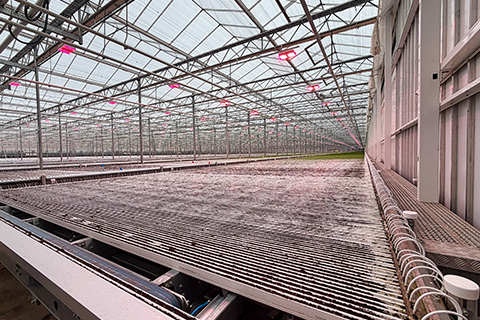 The new operations are all identical in size and layout: about 480,000 sq. ft. total, including all the seeding, germination and packing areas. The 8-acre (350,000 sq. ft.) Kubo greenhouse is divided into two mirror-image 4-acre sections, each served by its own seeding line. Eric told us that with 60,000 20-ft. growing gutters in the greenhouse, each holding 300 plants, and getting 16 turns per year from the space, that’s close to 300 million lettuce plants per year—in other words, scale—a lot more than they could get from a rooftop or a floating raft system. And for the future, each new location has property enough for three more 8-acre blocks.
Newly germinated gutters of lettuce enter the greenhouse for the 20-day trip from one end to the other. Gutters are about 20 ft. long. There are roughly 60,000 of them in the 8-acre greenhouse at any moment. They turn the greenhouse about 16 times a year.
Of course, there’s fierce competition for grocery shelf space. What does BrightFarms see as their competitive advantage?
People, for one, says Eric—although he admits that sounds a little bit cliché. “Probably everybody says that. But I get to work with some amazing, dedicated people that are really interested in making not just our business, but this industry, work. I think that’s super important.”
Another advantage is their Kubo Ultra-Clima semi-closed greenhouses because, at $2 million or more per acre to construct, not everybody can put one up. And that’s just the greenhouse— double or even triple that figure for the land, infrastructure, gutter system, coolers, packing lines and so forth. But it’s the only way to provide optimum lettuce-growing conditions year-round. “Frankly we couldn’t be growing successfully the way we have in Georgia and Texas without it,” Eric says of the Kubo. And the mobile gutter system from Green Automation reduces labor costs, which can kill a greenhouse operation. Yes, others can spend millions on the same tech, but BrightFarms has first-mover advantage in many regions. Anyone else will be playing catchup while BrightFarms add another 8 acres.
 How does Georgia fit the new strategy?
To visit BrightFarms, we drove six hours north to Macon from Orlando (2.7 million population), making that relatively “local.” Macon is also convenient to Atlanta (6.4 million), Jacksonville (1.6 million), Tampa (3.2 million), Birmingham (1.1 million), Nashville (2 million), Charlotte (2.8 million) and more—something like 60 million potential salad-eaters within an 8-hour radius. While Macon might seem an unlikely choice, it’s definitely a strategic one, and a shift from the company’s previous “local” strategy of a few miles.
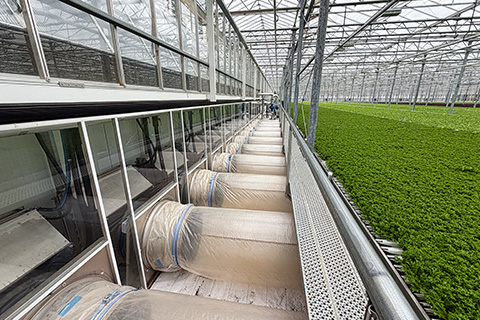
The business end of the Ultra-Clima greenhouse: the treatment corridor, from which cooled (or heated), dehumidified, CO2-enriched air is sent into the greenhouse via perforated poly tubes that run beneath the crop. There are evaporative pads, but the real cooling is done by four giant chillers located outside the greenhouse.
“We’re still way more local than [lettuce] from California or wherever else,” Eric offered. “Ideally, we’re trying to hit that hub of 300, 400 miles around the greenhouse. Obviously, Georgia’s got nice populations outside of Atlanta and we can cover that whole Southeast region, the same with what we’ve done in Texas and Illinois.”
It’s a bonus that new owners Cox Farms are just up the road in Atlanta, which is why they chose Macon as home for a “Discovery Center”—an impressive meeting space adjacent to the greenhouse to host visitors, vendors and customers (complete with coolers in which the sales team can build sample displays), and a boardroom that looks into the greenhouse so guests can see the lettuce without having to don lab coats and hair nets. They’ve designed hands-on educational tools for school groups, too—perhaps inspiring the next generation of greenhouse growers.
“Cox has been an absolutely amazing owner,” says Eric, mentioning Cox’s long-term investment in cable television infrastructure years ago, and how they want to do the same long-term investment in CEA. “It’s not your typical private equity—‘Hey, I want to be in for three to five years and get out.’ It’s been, ‘Hey we see the future of this, we want to go be a vendor that is really a retailer’s choice.’ It’s really a long-term strategic play, which is awesome.”
But lettuce in the Deep South?
A key question isn’t whether or not BrightFarms can grow lettuce—they’ve been doing so successfully for more than a decade. And the 18 million plants we saw looked perfect. But it was early March. What about July, when the average high temperature in Macon is 92F?
 The Kubo Ultra-Clima greenhouse is a semi-closed design, meaning climate control is done “by actively controlling the physical properties of the air that enters the greenhouse, the air exchange between inside and outside, the treatment of the inside air via recirculation, and the air flow within the greenhouse” (as stated by a research paper on the topic). Cooling of the ambient air comes from four giant electric chillers outside the greenhouse that feed into an air treatment corridor, which in turn send cooled, dehumidified, CO2-enriched air beneath the crop via large, perforated poly tubes. Above, shade curtains reduce solar heat gain.
One feature we noted—but which BrightFarms politely declined to discuss—was the exact gutter height of the greenhouse. This is a TALL range—at least a meter taller than typical, to our eyes. Perhaps it was our imagination … or perhaps Kubo gave this house extra height for added climate buffering, which might be one more key to maintaining an optimum growing environment in the Deep South.
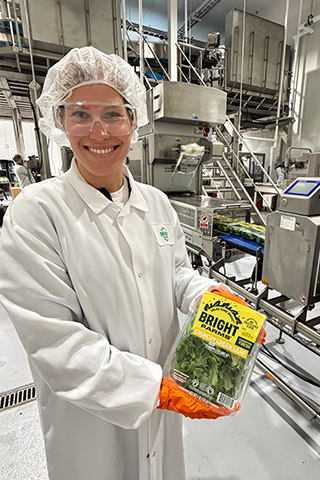
Brand Manager Kayla Michelson shows off some of BrightFarms’ finished product. Each of their new regional hubs produces about 6 million pounds of lettuce per year from 8 acres.
Speaking of which, Eric and his growing team have now been through a full summer season at both Texas and Georgia. How did it go?
“We were really pleased with how the system worked, overall,” he replied, joking that the maintenance crew has to be right on top of any issues with the four critical chillers. “If one of those goes down, you’re looking to get that repaired really quick!” But other than first season teething pains, product went well, with only about a 5% decrease in production in the peak of summer, while maintaining the quality that customers demand. “Hopefully, we’ll get it even tighter, but yeah, for the first go at it, we’re pretty happy with that.”
In 2022, showing its commitment to CEA, Cox Farms acquired Mucci Farms, headquartered in Kingsville, Ontario, Canada, a second-generation vine-crops grower. If anyone knows CEA vegetable growing, it’s the Mucci family; they went from field to greenhouse way back in the ’70s. We asked Eric if there are synergies between Mucci and BrightFarms.
 “Absolutely,” he answered. “It’s been a fun journey to get to know those guys. Danny Mucci was down with us the other day on a customer visit. They’ve got some relationships with people that we don’t, and we’ve got some relationships with people that they don’t. On the operations side, we’re starting to integrate and do things like, ‘Hey, should we use the same maintenance software?’ Which makes a ton of sense, right? They’ve built an amazing business, we have a ton of respect for them.”
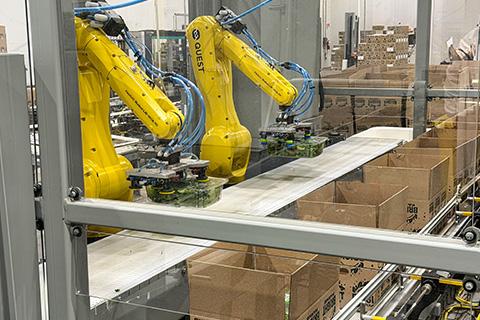
Robots speed the boxing process.
The next move?
While rapidly expanding companies often want to keep the answer close to the vest, it never hurts to ask about the next phase for a company—in BrightFarms’ case, does that mean continued expansion of their three hubs? Are there more hubs in the works? A combination thereof?
“You know, certainly it’s going to take us a minute to continue to get these three [built] out. There’s been a lot of growth really fast, and we’re trying to make sure we do it right. Like we talked about, there’s opportunity to add a second eight acres in Georgia, Illinois or Texas. I think we’re going to let the market tell us where to go first … Georgia is maybe a decent guess.”
And what about technical innovations? You’re on the cutting edge today … how do you stay there?
“You know, it may be a little bit counterintuitive, but the way I think about it is, I don’t necessarily want to be the Formula 1 car. I want to be a really solid F150,” Eric answered. “We’ve got a lot of good partners out there, and ultimately what we’re trying to do is be really good operators. There’s been a lot of technology that people have implemented—I won’t pick on anybody, and I think it was all with good intent—but you got to make the whole system work. That’s what we’re focused on.” IG