1/30/2026
A CEA Crop Like No Other
David Kuack
Berry production continues to gain interest from controlled environment growers looking to expand their offerings beyond the traditional food crops of leafy greens, tomatoes, cucumbers and peppers. Strawberries, in particular, are seeing expanded trialing and production in controlled environment production systems.
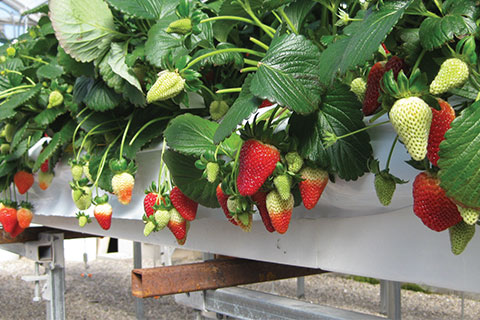
Controlled environment strawberries are typically grown in slabs, troughs or containers. Photo courtesy of Mark Kroggel, The Ohio State University.
Similar … but not
Controlled environment strawberry production is similar to other controlled environment food crops in that growers are using modified environments to overcome the outside environment to optimize crop production. That’s where the similarity ends.
“Strawberry production is different from crops like tomatoes and cucumbers, which typically are produced in high wire systems,” said Mark Kroggel, who’s a CEA lecturer in the Department of Horticulture and Crop Science at The Ohio State University. Mark has been conducting research with controlled environment strawberries since 2009.
He added strawberries are grown as a low row crop, typically on a slab, in troughs or in containers. Raised gutters are often used to produce strawberries so workers don’t have to bend over, which makes it easier for plant maintenance and fruit harvesting. Leafy greens, another low row crop, are grown in entirely different production systems, typically nutrient film technique (NFT) or deep water culture. Strawberries like tomatoes, cucumbers and peppers require canopy maintenance, but strawberries are a more complex crop to produce.
“Just one mistake with strawberries can lead to months of no flowers or fruit,” Mark said. “When we started working with strawberries we had grown every other food crop. We expected it would be easy to grow strawberries in a greenhouse. It is a lot more challenging than we expected it would be. The plants respond to so many different things. It took me about two years to feel comfortable with being able to predict what might happen with the crop.”
 In fact, the controlled environment growers who may be better prepared for the production complexity of strawberries are actually cannabis growers.
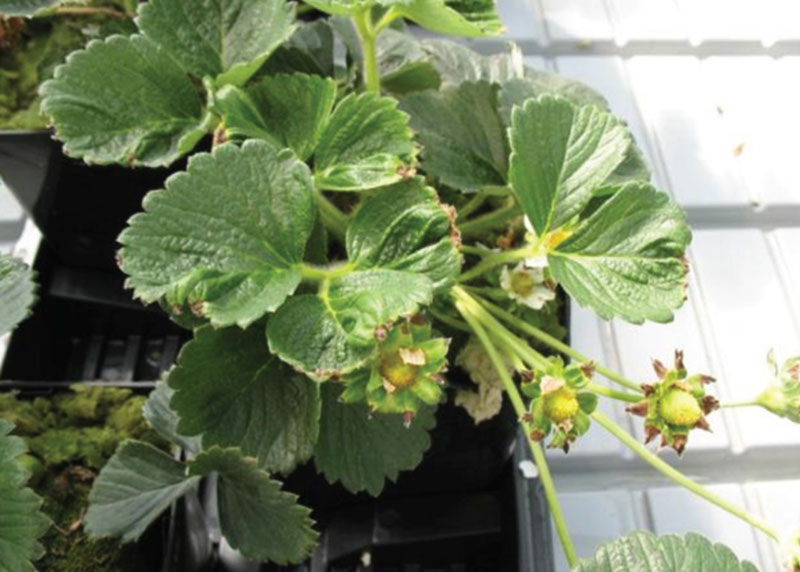
If the humidity at night is less than 75% in the greenhouse, then strawberry plants tend to be susceptible to tipburn, which can occur on the leaves and calyx. Photo courtesy of Mark Kroggel, The Ohio State University.
“Cannabis plants are very sensitive to the environment and respond very dramatically to the changes in the environment,” he said. “We are working with a strawberry grower who spent four years producing cannabis and she is still trying to figure which of these two crops is more challenging. There are more similarities between those two crops than to other food crops.”
Lower light requirements
Food crops like tomatoes and cucumbers grow better under high light levels. Strawberries do, as well, up to a certain level.
Research conducted at the University of Arizona showed strawberry plants are very sensitive to light, said Karla Garcia, technical service specialist at Hort Americas and CEO of Microgreens FLN.
 “If there is too much light in the greenhouse there can actually be a reduction in photosynthesis over time in strawberry plants,” she noted. “The use of shading to reduce the light intensity is important. Typically, shading is used with other greenhouse crops to regulate temperature and to avoid high radiation. However, with strawberries shading is used to reduce photons of light to avoid a negative impact on photosynthesis. Light can stress strawberry plants, which also applies to other berry crops, including raspberries and blueberries.”
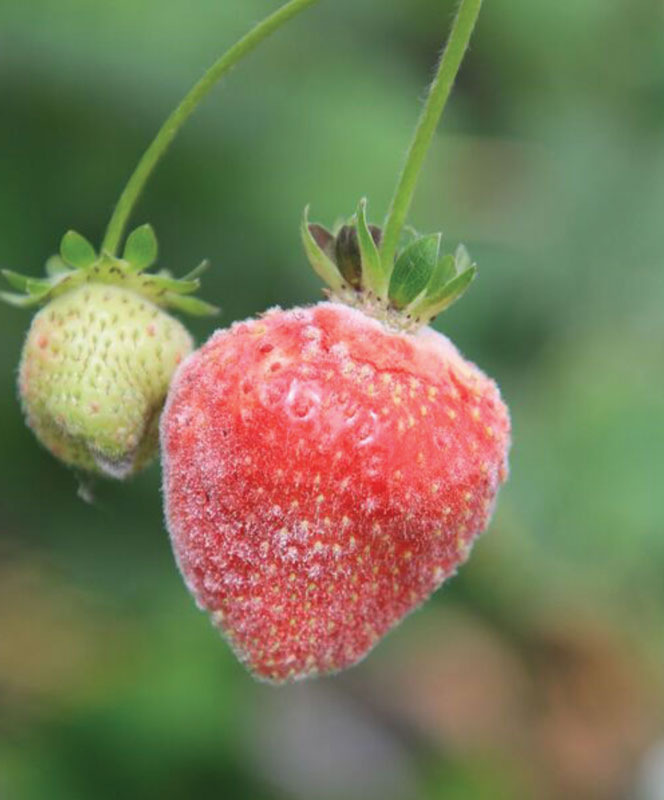
While powdery mildew usually isn’t an issue on field-grown strawberry plants, the disease is a common problem for most growers of greenhouse strawberries. Photo courtesy of G.J. Holmes, Cal Poly Strawberry Center.
Karla added the optimum daily light integral (DLI) for tomatoes and cucumbers is 20 to 30 moles of light per square meter per day (mol·m-2·d-1).
To compare, for lettuce the DLI should be 17-20 mol·m-2·d-1, she said. For strawberries, blueberries and raspberries, if the DLI is more than 20 mol·m-2·d-1in the greenhouse, there can be a reduction in photosynthesis.
“The main difference is, if lettuce is grown in more light that usually isn’t a problem,” she emphasized.
Strawberries need a minimum DLI of 15 mol·m-2·d-1. Mark noted a lower DLI results in plants that can’t produce the quantity and quality of fruit for the crop to be considered successful.
 Impact of temperature
Night temperature is linked to flavor of strawberries more than the day temperature.
For controlled environment strawberries the maximum electrical conductivity (EC) should be around 1.2 mS/cm. A higher EC can lead to the production of more runners and less fruit. Photo courtesy of Mark Kroggel, The Ohio State University.
“If the night temperature is above 60F the taste becomes more acidic,” Karla said. “The night temperature should be maintained between 50 to 59F. If the temperature is lower or higher than this range, the plants will still produce strawberries. Below 50F and the plants grow more slowly.”
Mark said tomatoes grown in the same night temperature range as strawberries would result in chilling injury and lettuce would grow very slowly. Meanwhile, for strawberries, if the night temperature goes above 57F the fruit quality starts to suffer due to fruit respiration, he said.
“Growing strawberries at warmer night temperatures, there may not be a loss of Brix (sugar content), but the acidity level in the fruit increases to the point where the taste is affected and it becomes a tart fruit,” Mark added. “The day temperature range for strawberries is more typical of other food crops at 68 to 75F.”
Karla who works with both U.S. and Mexican growers, and said Mexican growers producing strawberries for customers in the U.S. are being asked to produce berries with Brix levels above 7.
“A Brix level of 8 to 10 is very sweet for the American market,” she said. “However, this Brix level is commonly reached in field-grown strawberry cultivars from other countries.”
 Impact of humidity
Tipburn on strawberries is usually related to the environment, specifically the humidity level at night. The cause of tipburn in strawberry is the same as in lettuce, which is a calcium distribution issue. Typically, there’s an adequate level of calcium in the nutrient solution, but it’s not getting to the parts of the plants that need it.
Karla said the night humidity level should be 75%, and if it’s less than that, the plants tend to be susceptible to tipburn. In places like Arizona where the humidity is very dry, Mark said under-bench fogging is used to increase the humidity level to near saturation levels, which eliminates tipburn.
For growers who are unable to maintain a night humidity of 75%, the humidity can be increased to 95% for three hours. This helps to move calcium through the plants. After three hours the humidity should be lowered back to 75%.
Growers should avoid extended periods of humidity levels above 80%, which can result in disease issues. Powdery mildew, which typically isn’t an issue on plants in outdoor production, is a common disease problem for growers of controlled environment strawberries.
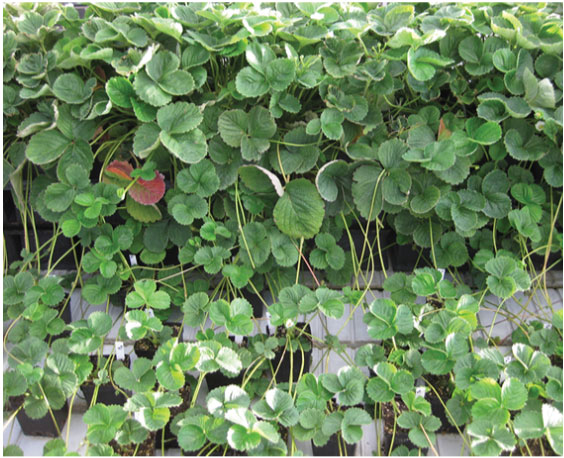
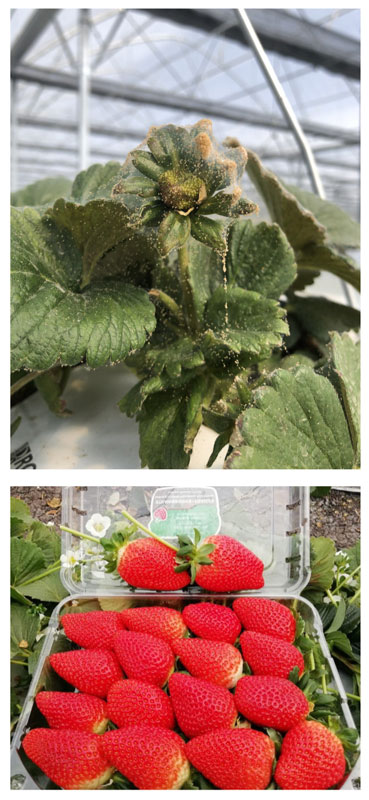
Top: Spider mites are one of the most common pests found on strawberry starter plants. It’s recommended to have a protocol in place to initially isolate the plants and to use biological controls to prevent the pest from entering production greenhouses. Photo courtesy of Karla Garcia, Hort Americas.
Bottom: Strawberries need a minimum DLI of 15 mol·m-2·d-1 in order to produce an adequate number of quality berries to be considered a successful crop. Photo courtesy of Álvaro Almejo.
If mild tipburn occurs on strawberries, it’s not going to affect plant productivity, but could impact saleability.
“There may be some tipburn on the leaves and calyx, but it won’t have much impact on photosynthesis,” Mark said. “However, with some strawberry varieties the tipburn can be quite severe, which impacts photosynthesis resulting in lower fruit production.
“Calyx tipburn occurs along with leaf tipburn. Tipburn on the calyx, which is the green cap on top of the fruit, causes brown tips. Calyx tipburn has no impact on the quality of the fruit, but U.S. consumers look for perfect fruit without any blemishes. It is entirely an appearance issue. Chances are a clamshell of big beautiful strawberries with calyx tipburn is not going to sell.”
Salt sensitive
Fertilizer can have a big impact on strawberry plants, which are very sensitive to salts.
“The electrical conductivity range for other food crops is 2 millisiemens per centimeter (mS/cm) or higher,” Karla said. “For strawberries, the maximum EC should be around 1.2 mS/cm, which is really low.”
Strawberries also prefer a low pH (5 to 6). If the pH is higher, around 7, there can be an issue with iron deficiency. Using chelated iron (DPTA or EDDHA) can mitigate the deficiency at pH up to 7.
“If there is a high EC some of the nutrients, including nitrogen, will be at higher levels resulting in the production of more runners, which is the way the plants replicate themselves,” Karla said. “Growers don’t want more runners because the plants are wasting energy. Growers are trying to produce more berries. Runners are produced all the time, but if too many runners are produced, it causes lower fruit yields. If plants are producing a lot of runners, growers need to check the fertilizer formulations and levels.” IG
David Kuack is a freelance technical writer in Fort Worth, Texas. Email him at dkuack@gmail.com.