CEAs Deadline Extended!
From Jen P.
Between the Great Outlook Outage of 2026 and a few other tech issues in the past week, we wanted to give you a little more time to get your nomination form in to be recognized at this year’s CEAs—Cultivating Excellence Awards at Indoor Ag-Con. These awards, provided by Indoor Ag-Con and Inside Grower and sponsored by Premier Tech, highlight the best in controlled environment growing and product innovation.
The extended deadline for all of this is Friday, December 4, so CLICK HERE to get the details on each of these awards and fill out your nomination forms today!
We are taking nominations for the Operational Excellence Award for growers, and for Product Innovation for manufacturers and allied trade. If you’d like to suggest a candidate for our Trailblazer Award, email me at jpolanz@ballpublishing.com.
A special thank you to our sponsor:

Local Bounti Buys Revol Greens
After a difficult summer that sent lettuce sales plummeting for many producers nationwide, Revol Greens announced in a WARN notice filed August 5th that it would close its doors and lay off staff. That is, if a buyer wasn’t found.
Fortunately, Local Bounti has stepped up to purchase the two flagship facilities Revol operated in Minnesota and Texas. Together, the new assets add 30 acres of greenhouse space, growing Local Bounti’s production footprint by roughly 70% to about 73 acres. Perhaps more important than the total acreage, the Minnesota facility extends Local Bounti into a new region, as its existing facilities mainly serve the Mountain West, the West Coast, Texas and the Southeast.
Local Bounti has been growing for quite some time. Starting in Hamilton, Montana, the company has spent the last eight years building and acquiring more and more greenhouses. Along the way, it has operated, and continues to operate, a variety of production models.
With such a wide portfolio of production systems, environments and products within the leafy greens world, Local Bounti likely understands these recent trends in indoor growing and how to leverage vertical farming tech, and it seems well positioned moving forward. I was a little heartbroken that Revol couldn’t weather this summer’s Cyclospora storm, but with Local Bounti continuing to operate those facilities, it’s good to know those greenhouses and their staff will keep growing.
Read more here.
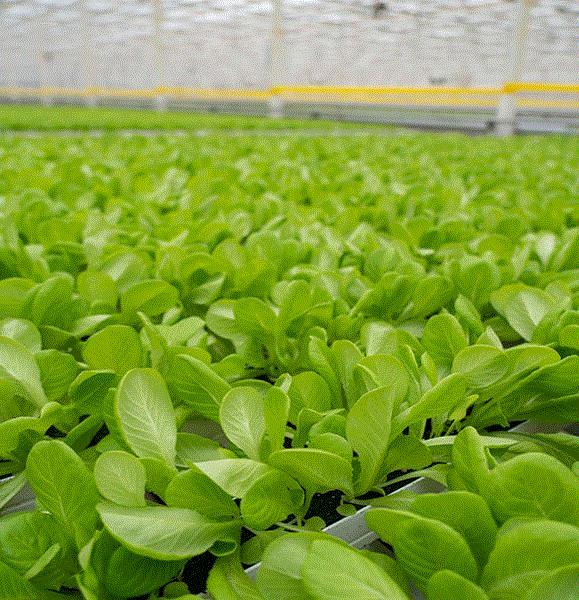
Baby leaf lettuce growing in Local Bounti's patented system.

A Bit About Modern Trends
Watching the industry, we’ve seen a few recent trends. Local Bounti has run a lot of different systems, and continues to, while also settling on a preferred design.
Local Bounti (along with Gotham Greens, Little Leaf Farms, Cox Farms and other major lettuce companies) runs what I’d consider the standard high-value North American production paradigm. Their main production method for baby leaf lettuce generally goes like this: multiple seeds per plug are sown into trays of polymer-bound peat or coconut coir plugs, like a Jiffy Preforma product. Plants are germinated, then transplanted into a moving gutter system filled with some type of media or substrate. The lettuce is then machine harvested for mixed salads or packed whole.
A couple of things stick out to me about this production system, including some I don’t fully understand. I’ll lay out my logic, but take it with a grain of salt. There’s some speculation here, and I may be missing the bigger picture.
During my training and early career, I was taught that hydroponic substrate is mostly for root support and little else, at least with leafy greens. Some crops, like melons, are known to be sensitive to water status and controlling drought stress, particularly close to harvest, is critical for quality. In CEA, fruiting crops like tomatoes and strawberries require this balance, but the old conventional wisdom for leafy greens is that water culture is sufficient. The leafy greens greenhouses I toured were almost exclusively deep water culture. Whether it was seeding on one side and harvesting on the other, or plant lazy rivers, the labor savings of rafted DWC seemed overwhelmingly smart.
So why, in 2026, are substrate-filled NFT channels dominating commercial production?
First, even when large-scale production was dominated by DWC, smaller growers still used NFT. It was thought to yield modestly higher and be less susceptible to root diseases thanks to better oxygenation. Automation eventually caught up, and the labor savings of DWC could be replicated with virtually any system type. Even so, a concrete basin is cheaper than a mechanized system. So even if automation closed the labor gap between NFT and DWC, why were growers willing to pay more upfront? And why are they paying even more to fill those NFT channels with substrate?
I think it’s likely the same reason Local Bounti prefers a vertical farm for seedling production: consistency. During my time at Davis, my advisor, Dr. Heiner Lieth, described hydroponic systems as the “racecars” of plant growth. In his words, this was a double-edged sword. These systems can grow plants incredibly quickly, but they can also fail catastrophically and kill plants in a matter of hours. DWC systems are the least susceptible to a crash. Water is always abundant, oxygen can take a day or more to deplete to dangerous levels, and the thermal mass of the water keeps temperatures stable. NFT is different. A thin plastic gutter with a narrow stream of water is a recipe for inconsistency at commercial scale. The occasional clogged line in a traditional CropKing or AmHydro NFT system is annoying, but in the small systems I’m used to running, with a few thousand plants at most, a clog is easy to spot. A 5-acre greenhouse can’t rely on someone catching a clogged gutter in time.
Substrate compensates for that weakness. In a moving system, a bad emitter might miss a watering on every channel that passes it, but the substrate holds enough water that growth isn’t affected before the next emitter waters that channel. Roots also grow throughout the substrate instead of matting along the bottom, so they’re less likely to clog the channel. As a final bonus, the extra mass helps keep temperatures steady. It’s an easy-to-implement fix for NFT’s biggest scaling challenges, and the best solutions are often simple.
So the shift from DWC to NFT makes sense: small, modular growing systems that allow quick turnover and make problems easy to isolate; machine automation that keeps the ease of movement DWC offered; and substrate-filled channels that provide more stable conditions and buffer plants from potential issues. All of these changes are about keeping what was good about DWC while taking advantage of the modular NFT form factor. I think the reason this growing method is absent from the universities I’ve attended is that none of these changes necessarily improve plant growth. They all come down to understanding the value of consistency, and how to achieve it at scale.
That’s not to say there haven’t been improvements in plant growth. Local Bounti’s hybrid vertical farm and greenhouse system makes a strong case for that. But in a world of vertical farms, color-changing LEDs, and robotics everywhere, it’s a good reminder that an old, passive technology like engineered plant substrate can be a powerful tool for solving consistency issues in commercial-scale NFT production. Substrate may also be needed to support some microbial interactions, and with the market overflowing with new biostimulants and microbial inoculants, it may simply be necessary.
Personally, I think it’s a bit boring. I’m much more of a fan of the new, futuristic fogponic systems, like the one developed by LettUs Grow. Way more fun.

DuPage Hort Apprentice Program
For students interested in the greenhouse industry, the College of DuPage Horticulture Apprenticeship Program offers a comprehensive mix of education and on-site training. The two-year program combines coursework at College of DuPage in Illinois with paid internships at large-scale commercial greenhouses from British Columbia to New York.
Without a doubt, the most impactful part of this program is the earn-while-you-learn model, not only for the financial support but for the real-world experience. Students receive an associate’s degree on completion and have the chance to make a few friends working in the industry.
Applicants must apply to both the college and the horticulture apprenticeship program. If you or someone you know is interested, follow the link here for more.
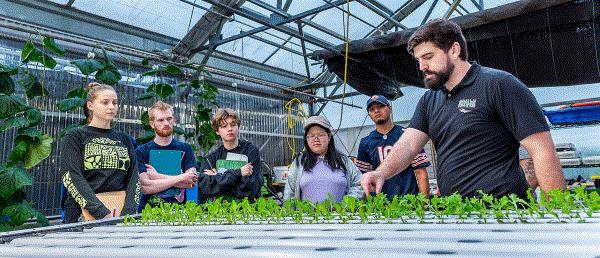
Photo credit College of DuPage
U of Georgia Fertilizer Research
Husnain Rauf in Dr. Rhuanito Soranz Ferrarezi’s lab at the University of Georgia recently published a paper in Scientific Reports on sap sampling for nutrient analysis. The study tested how sampling choices, such as the number of leaves, leaf age, time of day and crop stage change the sap nutrient readings in lettuce and tomato.
Consistent sampling protocols are what make sap testing useful, giving growers reliable information about the nutrient status of their crop. The paper shows just how many ways sampling can shift the numbers, so the real take-home is to be consistent above all else.
Coming full circle, this USDA-funded project was carried out with industry partners Kalera, Pure Flavor and Local Bounti.
Read the raw science here.
OHCEAC Strawberry Course
The Ohio Controlled Environment Agriculture Center (OHCEAC) will offer its online Strawberry School this winter. The deadline to enroll is November 30, so sign up soon!
The six-lecture, self-paced course covers the essentials of soilless strawberry production in greenhouses and indoor farms. Course materials are already available to those who have signed up and will stay open through January 10.
This summer, after Cultivate, I had the chance to tour OHCEAC with Dr. Garrett Owen. Without a doubt, instructors Dr. Chieri Kubota and Mark Kroggel know how to grow some amazing plants.
Learn more and sign up for the course here.
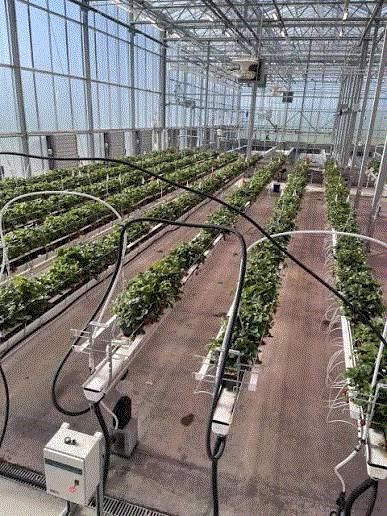
A view from inside the OHCEAC strawberry production teaching facility.

Dr. Jake Holley
Editor-at-Large
Inside Grower
This email received by 39,984 loyal readers!
Interested in advertising in Inside Grower? Contact Paul Black or Kim Brown and they'll show you how easy, effective and affordable it is.