Congratulations to the CEAs Winners!
Jen Polanz just sent this in direct from Indoor AgCon:
We were thrilled to be able to honor a grower, innovative supplier and an industry trailblazer at this year’s CEAs—Cultivating Excellence Awards at the Gala Luncheon at Indoor Ag-Con in Las Vegas.
In our second year hosting the awards program in conjunction with Indoor Ag-Con, we highlighted finalists in the categories of Product Innovation and Operational Excellence, and introduced the new Trailblazer Award to recognize someone in the industry who's made an impact through advocacy and education. We couldn't have done it without the support of our program sponsor PremierTech and we so appreciate CEA Commercial Director Nicholas Roy’s help in handing out our glass trophies.
And the winners are:
Product Innovation: Jiffy Gel from Jiffy Group
Operational Excellence: BrightFarms
Trailblazer Award: Dr. Gene Giacomelli
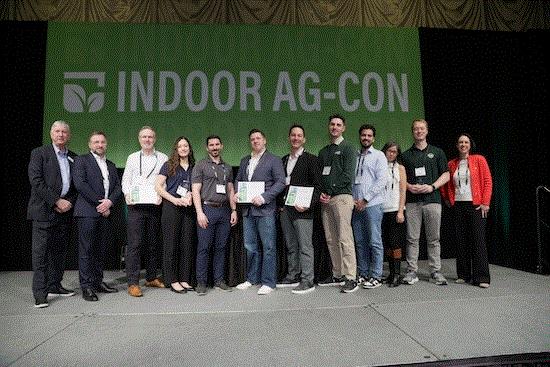
Thanks to everyone who made these awards happen and stay tuned for more details on next year’s event. In the meantime, block off your calendar for March 24-25, 2027 to head back to the Westgate in Las Vegas for Indoor Ag-Con.

Sollum Technology LED Purchasing Guide
Sollum Technologies, a supplier of commercial greenhouse LED lighting systems, has released a new guide titled "How to Choose the Best Commercial Greenhouse LED System." As someone who's worked in the LED industry and spent considerable time studying plant lighting strategies, it was refreshing to see a resource that presents the fundamentals clearly while also addressing the more nuanced considerations that often determine long-term success.
The guide begins with the essential criteria most growers are familiar with, including electrical efficacy, light output, capital cost and warranty coverage. These are still critical metrics, particularly as energy prices remain volatile and capital expenditures are scrutinized more carefully. However, where the guide becomes especially useful is in its discussion of the features that extend beyond fixture efficiency alone.
In the section titled "What to Look for in a Modern Commercial Greenhouse LED System," Sollum highlights capabilities that are becoming increasingly important in data-driven greenhouse operations. Features such as precise intensity control, DLI-based lighting algorithms and integration with existing climate and control systems reflect a broader shift toward infrastructure-ready lighting platforms. As AI-driven crop steering and advanced environmental controls become more common, lighting systems are no longer standalone hardware purchases, they're integrated components of a larger production strategy.
The emphasis on long-term service support and system scalability is also noteworthy. In commercial environments, lighting decisions affect crop quality, yield and operating costs for years. Selecting a platform that can adapt alongside evolving control software and production goals may ultimately prove more valuable than marginal differences in fixture efficacy.
For growers evaluating new installations or retrofits, the guide provides a helpful framework for thinking beyond upfront price and into total system performance.
Check out the guide at this link to learn more.

Sollum LEDs demonstrating spectral control in a greenhouse.

Controlled Environment Agriculture Herb Extension & Research Base
This summer, the University of Tennessee in Knoxville will host a joint annual stakeholder meeting focused on controlled environment agriculture (CEA) herb production and end-of-production leafy greens research. The meeting will bring together researchers, industry partners and growers to discuss current findings, ongoing projects and emerging opportunities within these rapidly evolving crop categories. The event will be hosted by Dr. Kellie Walters and Dr. Alicia Rihn of UT and will be held Monday and Tuesday, June 29 and 30.
The conference will feature speakers from a range of leading research institutions across the United States. Confirmed presenters include Dr. Roberto Lopez of Michigan State University, Dr. Jennifer Boldt of USDA-ARS, Dr. Brian Whipker of North Carolina State University and several other prominent researchers working at the forefront of CEA crop science. Together, they'll share updates spanning plant physiology, lighting strategies, nutrient management, postharvest quality and economic considerations in herb and leafy green production.
Topics will range from the impacts of UV light on flavor and nutritional quality to evolving consumer preferences in culinary herbs and value-added leafy greens. With increasing pressure on margins and heightened interest in differentiated products, sessions will explore both production efficiency and market positioning.
This meeting offers a valuable opportunity for growers, suppliers and researchers to connect directly with the scientists shaping CEA best practices. If herbs or leafy greens are part of your operation, or even on your radar, this is a strong chance to gain insight into where the research community is heading next.
Registration is free. Look out for more information on how to register soon.

USDA Pauses Loan Guarantees for Biodigester and CEA Projects
The USDA has announced a 90-day pause on new loan guarantees for biodigester and controlled environment agriculture (CEA) projects due to high delinquency rates and other portfolio concerns. The pause applies specifically to programs administered through the Rural Business-Cooperative Service (RBCS). During this period, the agency will review its existing loan portfolio to ensure fiscal responsibility and assess program performance.
For CEA-specific loans, approximately 43% are currently delinquent, representing roughly $135 million in outstanding balances. Those figures are significant and likely prompted heightened scrutiny within the program.
What remains unclear is the scale and structure of these CEA loans, particularly given that RBCS programs are designed to support rural development. Much of the high-profile financial distress in vertical farming has occurred in more urban markets, raising questions about the types of operations included in this portfolio. It's also unclear whether these loans primarily supported facility expansions, operational improvements or entirely new builds. The grouping of biodigesters, typically associated with dairy manure management, and CEA vegetable production under the same pause adds another layer of curiosity, as these sectors differ substantially in scale, risk profile and market dynamics.
Importantly, existing loans will not be affected. The pause applies only to new loan guarantees that have not yet been awarded. For full details, review the official USDA release and contact information provided in the link.

Leamington Greenhouse Grower Expo
The epicenter of North American greenhouse vegetable production, Leamington, Ontario, will hold its annual Greenhouse Grower Expo on February 25. Each year, the event brings together growers, suppliers and industry leaders from across the region to connect, compare notes and see what’s next in controlled environment agriculture. The show will host over 60 exhibitors, include a complimentary lunch and a full day of engaging round-table discussions focused on the future of greenhouse production.
If you’ve never visited Leamington before, it’s worth the pilgrimage. With over 3,000 acres of greenhouse production, this small town an hour east of Detroit has one of the highest concentrations of high-tech greenhouses anywhere in the world. It’s easily spotted if you’re flying over at night by the yellow, magenta and white glow of greenhouse lighting reflecting off the clouds. Leamington is also on a major avian migratory flyway, making it an important destination for “birders” hoping to spot golden-winged warblers to round out their exotic bird bingo cards.
And if the Olympics has you suddenly intrigued by ice shuffleboard, Leamington even has a curling club. After all, the U.S.’s Rich Ruohonen is competing at the youthful age of 54, so there’s still time for some of us to fulfill our Olympic dreams, starting with a trip to Leamington for the Grower Expo.
Learn more and register for the expo here.

Oasis RhizoPlug
Oasis Grower Solutions, a longtime provider of greenhouse and hydroponic substrates, has launched a new retail propagation product designed specifically for home growers. The new OASIS RhizoPlug brings the company’s commercial substrate technology to small-scale and hobby operations, bridging the gap between professional propagation systems and consumer gardening.
For growers familiar with Oasis products in commercial greenhouses, this is a notable shift. Traditionally associated with large-scale plug and cutting production, Oasis substrates are known for uniform moisture distribution, clean handling and consistent root development. Making that same technology accessible in a retail kit format opens the door for serious home growers, small greenhouse operators and educational programs to work with professional-grade materials.
As both a home grower and operator of a small greenhouse, having access to commercial-quality substrate on demand is a meaningful upgrade. Substrate remains one of the most innovative areas in horticulture, with ongoing development around water-holding capacity, air porosity, sustainability and root-zone performance. Being able to trial these materials at a smaller scale allows growers to better understand propagation dynamics before scaling up into larger production environments.
The OASIS RhizoPlug Sheet Propagation Kit includes standard 1020 trays, either 50- or 104-count RhizoPlug sheets and instructions for use. The plugs are designed to provide consistent moisture and structural integrity during rooting, supporting uniform germination and cutting establishment. For growers looking to refine propagation practices, reduce variability or simply experiment with higher-performance inputs, this kit offers a professional starting point.
Learn more about the OASIS RhizoPlug Sheet Propagation Kit at the link.

University of Florida Expands Greenhouse Training Online Program
The University of Florida has announced new course offerings in its award-winning Greenhouse Training Online program. Designed for growers, technical staff and industry professionals, these fully online courses cover a wide range of greenhouse production topics, including nutrient management, substrates, disease management and the newly added subject of plant growth regulators.
The program has built a strong reputation for delivering practical, research-based information in a flexible format that fits around production schedules. Whether you're looking to sharpen fundamentals or dive deeper into specialized topics, the curriculum is structured to provide both scientific context and real-world application.
Individual courses cost under $300 and can be combined to complete certificate tracks, such as the Plant Health Professional or Elite Grower programs. For growers looking to formalize training or invest in staff development, this is a relatively accessible way to build technical expertise.
Learn more and explore course options here.



Dr. Jake Holley
Editor-at-Large
Inside Grower
This email received by 36,284 loyal readers!
Interested in advertising in Inside Grower? Contact Paul Black or Kim Brown and they'll show you how easy, effective and affordable it is.