|
|

|
Crops for CEA
New Bluelab Website and ORP
Ohio State Tomato Academy
Global Produce Trade Show
CEA Summit East
-Taking the Time
-Getting Detailed |
|
 |
Creating Crops for CEA
I’m a dog person. Despite their almost unnatural friendliness and a few quirks that clearly separate them from their wolf ancestors (like asking permission before doing something) dogs still carry plenty of their heritage within them. Barking at strangers, chasing squirrels, guarding territory: all remnants of instincts that once meant survival. I like to call it dog culture, a collection of hardwired behaviors that still defy domestication. I often remind my dogs that many of these instincts are completely unnecessary, though it rarely changes their minds.
In controlled environment agriculture (CEA), we face a similar situation. Our goal is to shape the environment around the needs of the plant, optimizing every variable for growth, yield and quality. Yet the plants we cultivate bring their own “wild culture,” traits and responses honed by millions of years in unpredictable, outdoor environments. Even though we can now offer them ideal lighting, steady humidity, perfect nutrition and consistent day lengths, plants still carry ancient instincts for survival: stress responses, shade avoidance, photoperiod sensitivity, dormancy triggers and defense mechanisms.
CEA opens the door to growing in ways nature never intended, unnatural lighting spectra, day lengths that defy the 24-hour cycle, and soil-free hydroponic systems, but the plants themselves are still wired for a world of fluctuating light, hunger and competition. Those ingrained adaptations, while once essential, can sometimes limit yield or efficiency in a controlled setting.
Just as a dog doesn’t need to chase every squirrel it sees, a lettuce plant in a well-managed greenhouse doesn’t need to hoard energy for drought or wind resistance. The next frontier of CEA may lie not only in refining the environment around the plant, but also in understanding the instincts the plant brings with it, and modifing genetic traits that no longer serve it.
I recently read a scientific paper Turbocharging Fundamental Science Translation through Controlled Environment Agriculture argues that CEA isn’t just a tool for yield, it’s a research platform to reshape the plants themselves. By coupling environmental control with genetic design, scientists can begin stripping away unnecessary “wild” traits, much like training out instincts that no longer serve a modern purpose. Controlled environments could support plants with streamlined metabolisms, reduced stress responses, and even reprogrammed circadian cycles—plants designed for reliability and efficiency rather than survival. It’s a vision of balance: not just shaping the environment around the plant, but shaping the plant to belong in a CEA environment.  New Bluelab Website and ORP Probe
Trusted supplier of fertilizer monitoring equipment Bluelab has launched a new website, now organized into Home Grow and Pro & Commercial sections. The new layout makes it easier to find the tools and resources needed to monitor and control fertilizer solutions.
What caught my attention most is Bluelab’s new Oxidation-Reduction Potential (ORP) Probe Sensor Kit. ORP is an area of research I’ve recently started exploring as a promising frontier in hydroponics. In applications like wastewater treatment and swimming pools, ORP serves as a reliable indicator of water sanitation, measuring the oxidizing potential of chemicals such as chlorine to ensure microorganisms like algae and pathogens are eliminated.
Within hydroponics, I see potential for ORP sensors in several key areas. While not a direct measure of dissolved oxygen, ORP readings can reflect changes in oxygen levels, meaning a sudden drop could signal root rot, a failed aeration system or an algal bloom. For growers using oxidizers like ZeroTol or hypochlorite, ORP sensors can help fine-tune dosing to find that sweet spot between sanitizing effectively and avoiding root damage. ORP may also prove valuable in tracking nitrification and microbial activity in organic or aquaponic systems.
I’ll be testing this new probe in my own greenhouse and sharing what I learn.
Check out Bluelab’s website here.  Ohio State Tomato Academy
The Ohio State University Greenhouse Tomato Academy is returning this fall with a refreshed format designed for accessibility and depth. Traditionally a one-week, in-person training, the program will now run virtually over four weeks, with an optional two-day, hands-on session in Columbus, Ohio.
The Academy will be led by Drs. Jason Hollick, Chieri Kubota, and Mark Kroggel, each bringing extensive experience in controlled environment crop production and research. Sessions begin Thursday, November 6, and continue every Monday and Thursday through December 1, followed by the in-person training on December 4–5.
Each week focuses on a different layer of greenhouse tomato production:
• Week 1: Greenhouse design, crop physiology and energy management fundamentals
• Week 2: Climate control, light management and integrated pest management
• Week 3: Root zone management, irrigation strategy and nutrient formulation
• Week 4: Crop scheduling, grafting, harvest quality and troubleshooting common production issues
The in-person portion offers hands-on practice with pruning, grafting, nutrient monitoring and environmental control exercises inside OSU’s greenhouse facilities.
For commercial growers, educators and researchers, this hybrid structure provides both flexibility and technical depth, a chance to update skills and interact directly with OSU’s greenhouse faculty and peers in the industry.
Learn more and register for the Greenhouse Tomato Academy here.
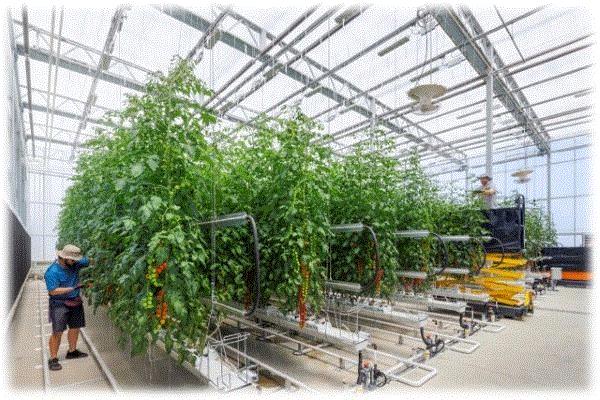
The Ohio State University's tomato production system used for the workshop.  Global Produce and Floral Show 2025
The world’s largest fresh produce and floral expo kicks off next Thursday, October 16th, in Anaheim, California. The Global Produce & Floral Show will feature hundreds of booths, exhibits and panel discussions covering every corner of the produce supply chain.
While the Cultivate trade show tends to spotlight greenhouse technology and grower innovation, this event takes a different angle, focusing on marketing, distribution and consumer trends in fresh produce. The emphasis is on supply chain connections, market opportunities and how growers can position their products in front of retailers, distributors and foodservice buyers.
Many well-known controlled environment agriculture (CEA) companies, 80 Acres Farms, BrightFarms, Mastronardi, and Mucci Farms, among others, will host booths at the show, alongside major retailers, packaging firms and import/export groups.
If you are aiming to better understand produce sales, branding and distribution networks, or looking to expand market reach, this event offers a valuable chance to see what buyers are looking for, and to meet them face-to-face.  CEA Summit East Taking the Time
As I continue to attend events in the controlled environment agriculture space, I see more growers opening up about their operations and lessons learned as they navigate the complexities of growing indoors. If you haven’t been to an in-person event, or it’s been a while, I would urge you to get out there to network, learn and share with other growers.
In mid-September I attended the CEA Summit East in Virginia, presented by Indoor Ag-Con and the CEA Innovation Center, a partnership between Virginia Tech and the Institute for Advanced Learning and Research (IALR). This is the fourth year for the event, and it continues to grow and become more even more valuable.
There were some great pieces of information shared that could be the difference in moving operations forward. I was honored to be able to moderate the first day’s keynote panel, “Cultivating Sustainable Growth: Balancing Economics and the Environment in CEA,” where expert panelists discussed the key drivers in profitable and sustainable operations, the pros of co-location, the importance of choosing the right site for climate and much more.
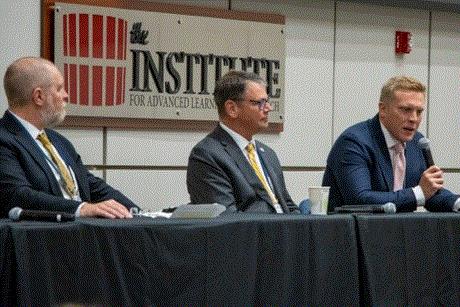
The keynote panel I moderated, from left to right: Roger Beulow, Chief Technology Officer, COFRA Sustainable Food Group; Matthew Lohr, Virginia Secretary of Agriculture and Forestry, Office of the Governor of Virginia; and Ben Alexander, CEO, Pluck’d.
 Getting Detailed
There were very granular sessions, too, that dove into diagnosing crop deficiencies, talking to growers about their experiences and how they reached profitability, and pest and pathogen identification and management that could improve crop yield. I will drop some of the details I learned from various sessions here, and I highly recommend checking out Indoor Ag-Con February 11-12, 2026 in Las Vegas for more of the same!
• From Lauren Houston, Jack’s Nutrients CEA technical specialist: She recommended having your water tested before selecting a fertilizer to better understand the makeup of what’s in your water (depending on the water source, it can vary). Testing your EC can determine if you are looking at low EC, which can indicate lack of nutrients, or high EC, which can be a result of excess of nutrients or salt accumulation, both resulting in poor plant growth. Also, a common deficiency for leafy greens is calcium, which can be impacted by high humidity and no airflow, which inhibits transpiration and results in tipburn (we have more about this in the upcoming November issue of Inside Grower). Understanding your rootzone pH will help you determine if the proper nutrients are being taken up by the crop, too.
• The second day keynote had growers talking about their path to profitability, both taking different routes. John McMahon, CEO of Equinox Growers, noted they started by growing for retail initially before entering into a partnership with large leafy greens supplier Taylor Farms, so they aren’t the brand themselves. That took some pressure (and expenses) off to be able to scale up. They’ve been in business for 10 years and now have roughly 15 acres total, 10 in production. John said they needed to get to 10 to achieve the unit economics that made them profitable. They are fully automated in production and harvesting, and had 120 years of growing experience among their team. Meanwhile, Carl Gupton, CEO of Greenswell Growers, is at under 1.5 acres and has focused on consistent product and taking the time to find the right market for their baby leaf greens. Two interesting keys to their production facilities they noted were understanding clearly how much cooling capacity you will need, and— when building new or retrofitting—however many floor drains you have, you likely will need more, and they are costly (this came up in multiple sessions). Carl also added they worked closely with their energy supplier to manage their demand and power needs to help with overhead costs.
• Avery Brickles, technical consultant for Koppert, presented during the pest identification and management session. She said pests come into the greenhouse or vertical farm in a variety of ways, including via substrate, clothing and outside propagated plants, and they can overwinter in weeds or in floors. She recommended starting with preventative measures versus waiting for infestations, and talked about monitoring best practices. She said it’s less about whether you have five or 50 thrips, but more about watching the trends and how it’s changing. Is it going down or up? For specific pests that are common on crops, she recommended educating every person who works on the crop via signs and posters with photos of damage and the pests to encourage faster detection.
There were many additional presentations, including unique research on the impact of wavelength on pests, a research update on microtomatoes in NFT systems from VT researcher Brandan Shur (see Brandan’s initial research here), more of Peter Konjoian’s ongoing research on using DDAC to sanitize hydroponic systems and its impact on crops (you can see his initial research here), and much more. If any of this sounds interesting to you, please make a plan to visit the show in Las Vegas or head to Danville, Virginia for the 5th Annual CEA Summit East September 15-16.
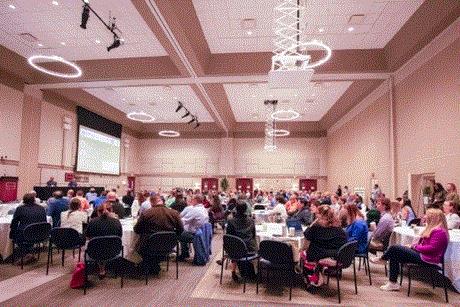
The room was packed the morning of the Day 2 keynote featuring growers Carl Gupton, CEO of Greenswell Growers, and John McMahon, CEO of Equinox Growers. This excellent session was moderated by CropKing CEO Paul Brentlinger.



Dr. Jake Holley
Editor-at-Large
Inside Grower
This email received by 34,526 loyal readers!
Interested in advertising in Inside Grower? Contact Paul Black or Kim Brown and they'll show you how easy, effective and affordable it is.
|